

Table of Contents
Objective:
This article aims to provide a comprehensive strategic analysis of the rapidly escalating HIV epidemic in the Philippines, the fastest-growing in the Asia-Pacific region. By examining epidemiological trends, demographic shifts, behavioral drivers, healthcare system gaps, legal and policy barriers, and successful community interventions, the study seeks to identify the root causes of the crisis and highlight actionable strategies for prevention, treatment, and sustained public health response. The ultimate goal is to inform policymakers, healthcare professionals, and community organizations on effective, evidence-based approaches to curb the epidemic and mitigate its long-term social and economic impact.
Determining the Scope of the Crisis
The Republic of the Philippines currently stands at a precipice of a public health catastrophe that is unprecedented in its modern history. While the global narrative regarding Human Immunodeficiency Virus (HIV) has largely shifted towards stabilization and chronic disease management, the Philippines has emerged as an alarming outlier. The country is currently experiencing the fastest-growing HIV epidemic in the Asia-Pacific region, a distinction that carries profound implications for its healthcare infrastructure, economic stability, and demographic future.
Between 2010 and 2022, while new infections plummeted globally, the Philippines registered a staggering 411% increase in estimated new annual infections. This resurgence has been described by international observers and the Department of Health (DOH) not merely as an increase, but as an exponential surge that threatens to overwhelm existing control mechanisms. Daily diagnosis rates have climbed from single digits in the early 2010s to nearly 50 cases per day in 2023, with projections for 2025 indicating a further rise to approximately 57 new cases daily.
This article is structured as a comprehensive dossier covering ten critical thematic areas – effectively ten distinct but interconnected “topics” – that collectively explain the mechanisms, drivers, and failures fueling this epidemic. It synthesizes data from the HIV/AIDS & ART Registry of the Philippines (HARP), UNAIDS surveillance, and academic research to provide an exhaustive analysis of a health crisis that has caught one of Asia’s most dynamic economies off guard.
Topic 1: The Statistical Tsunami: Unpacking the Epidemiology of Exponential Growth
To understand the severity of the Philippine situation, one must first confront the sheer velocity of the epidemiological curve. The transition from a “low-prevalence” country to one with a rapidly expanding concentrated epidemic has been swift and relentless.
The Velocity of Infection
The data indicates a sustained and accelerating upward trajectory. In 2010, the country recorded approximately 4,400 new cases annually. By 2024, this figure had exploded to 29,600 – a 550% increase in just over a decade. The Department of Health’s projections for 2025 estimate that around 252,800 Filipinos will be living with HIV. Without drastic and immediate intervention, this number is projected to nearly double to 401,700 by 2030.
The acceleration is visible in the month-on-month surveillance data. In 2021, the monthly average of new diagnoses was 1,027. By the first quarter of 2025, this monthly average had surged to 1,700 cases, representing a 50% year-on-year increase from the first quarter of 2024. This is not merely a statistical artifact of increased testing; the positivity rates and the volume of late-stage presentations confirm that transmission is intensifying.
The “Missing” Population and the Treatment Gap
The global benchmark for HIV control is the UNAIDS 95-95-95 target: 95% of People Living with HIV (PLHIV) knowing their status, 95% of those diagnosed on Antiretroviral Therapy (ART), and 95% of those on ART achieving viral suppression. The Philippines is failing critically across all three metrics.
| Metric | Target | Philippines Status (Q1 2025) | Implication |
| Diagnosis | 95% | 55% | nearly half of the HIV-positive population (~113,000 individuals) are unaware they are carrying the virus, acting as a hidden reservoir for transmission. |
| Treatment | 95% | 66% | Of those who do know their status, a significant third are not receiving life-saving medication due to stigma, logistical barriers, or system drop-out. |
| Suppression | 95% | 40% | Most critically, only a minority of treated patients have confirmed viral suppression. This renders the “Undetectable = Untransmissible” (U=U) prevention strategy ineffective at the population level. |
The gap in viral suppression is particularly alarming. It suggests that even among those ostensibly “in care,” the quality of monitoring is poor. Surveillance reports indicate that only 45-51% of patients on ART even undergo viral load testing, blinding clinicians to treatment failure or drug resistance.
The Burden of Advanced HIV Disease
The epidemic is not just growing; it is deepening in severity. A persistent failure of the healthcare system is the inability to diagnose individuals early. In April 2023, 27% of newly diagnosed individuals already presented with clinical manifestations of Advanced HIV Disease (AHD), formerly known as AIDS. By 2025, reports indicated a 12% rise in these advanced cases.
This “late presentation” phenomenon drives high mortality rates. In just the first quarter of a reporting year, hundreds of deaths are recorded. These are preventable deaths, occurring because stigma or lack of access delayed testing until the immune system had already collapsed. The presence of AHD at diagnosis is a definitive marker of a surveillance system that is reactive rather than proactive.
Topic 2: The Youth Bulge: Why the 15-24 Demographic is the New Epicenter
The demographic profile of the Philippine epidemic has shifted dramatically downward in age. What was once a condition affecting older adults is now undeniably a crisis of the youth.
The Statistical Shift to Adolescence
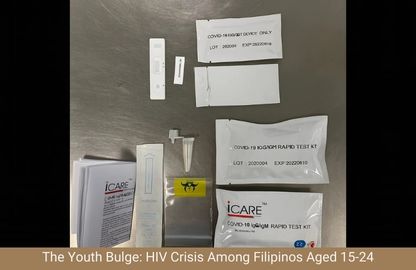
The “youth bulge” in HIV cases is perhaps the most distressing trend in the current data. In the first quarter of 2025, roughly one-third of all newly diagnosed cases were among young Filipinos aged 15 to 24 years. When the age bracket is expanded to include young adults up to 34 years old, this group accounts for the vast majority – up to 94-96% – of new infections.
The median age of diagnosis has trended downwards to 28 years old, with cases being reported in individuals as young as 15 without any history of perinatal transmission. This indicates that sexual debut is occurring earlier, or risk behaviors are intensifying rapidly during adolescence. In 2023, 47% of all reported cases were between the ages of 15 and 24.
The Vulnerability of the “Digital Native”
This demographic is the first generation of “digital natives” to face the epidemic. Their sexual socialization occurs largely online, where access to partners is instantaneous, but access to accurate sexual health information is often blocked by conservative algorithms or policy restrictions.
The youth are also economically vulnerable. Many are students or in early-career positions (such as BPO work), living with parents, and dependent on family support. This dependency creates a massive barrier to testing. The fear of parental discovery – which could lead to being kicked out of the home or cut off financially – is a potent deterrent. Even with the legal age of consent for testing lowered to 15 (discussed in Topic 8), the psychological barrier of “shame” within the family unit remains high.
Implications for Long-Term Healthcare
The infection of such a young cohort creates a “lifetime burden” scenario. A 19-year-old diagnosed today will require 50 to 60 years of continuous Antiretroviral Therapy (ART). This places an unprecedented long-term financial obligation on the Philippine health insurance system (PhilHealth). Furthermore, the long-term side effects of medication, the potential for developing drug resistance over decades, and the need for chronic disease management will challenge the healthcare infrastructure for the next half-century.
Topic 3: The Geography of Infection: From Metro Manila’s Congestion to the Central Visayas Injection Crisis
While HIV is a national concern, its distribution is highly uneven, concentrating in urbanized corridors that reflect the country’s economic geography.
Metro Manila (NCR): The Engine of the Epidemic
The National Capital Region (NCR) remains the unrelenting epicenter. Consistently, NCR accounts for the largest proportion of new daily infections, often ranging between 25% and 35% of the national total. The density of the metropolis facilitates the formation of tight, overlapping sexual networks.
Quezon City, the most populous city in the region, reports the highest number of diagnosed cases, acting as a microcosm of the national crisis. The region’s dominance in the statistics is partly due to better testing infrastructure – more people are found because more are looked for – but it also reflects the reality of high population density and the concentration of entertainment and nightlife districts.

The Central Visayas Anomaly: The Needle-Sharing Crisis
A unique and highly volatile sub-epidemic is occurring in Central Visayas (Region 7), anchored by Cebu City. While sexual transmission is the driver in the rest of the country, Central Visayas is the hub for transmission via sharing of infected needles.
Recent surveillance indicates that Central Visayas accounts for 99% of all HIV cases in the country linked to needle-sharing. This concentrated epidemic among People Who Inject Drugs (PWID) is a legacy of the region’s specific struggle with injectable drug use. While sexual transmission (MSM) is also rising in the region (ranking it 4th nationwide in total cases), the injection-driven transmission requires a completely different public health response – specifically harm reduction – which is politically fraught in the Philippines.
The “Bedroom” Regions: CALABARZON and Central Luzon
Regions 4A (CALABARZON) and 3 (Central Luzon) consistently rank second and third in case numbers. These regions effectively function as the suburban sprawl of Metro Manila. The daily commute of hundreds of thousands of workers between these provinces and the capital creates a “viral corridor.”
The high mobility of the workforce means that an infection acquired in a bar in Quezon City can easily be transmitted to a partner in Laguna or Cavite the same night. This geographic interconnectivity suggests that regional containment strategies are unlikely to work; a “Greater Manila” approach that encompasses these three regions is necessary for effective surveillance.
Topic-4 Modern Love and Algorithms: How Dating Apps and “Alter” Culture Rewired Transmission Networks
The mechanism of finding sexual partners in the Philippines has undergone a digital revolution that has inadvertently optimized the transmission of HIV.
The Role of Location-Based Dating Apps (LBDAs)
The rise of smartphone availability has correlated perfectly with the rise of the epidemic. Applications such as Grindr, Tinder, Blued, and Hornet have dramatically reduced the “search cost” for sexual partners. The United Nations and local researchers have identified the use of these apps as a significant driver of HIV spikes in Southeast Asia, including the Philippines.
These platforms facilitate “sexual efficiency.” What previously required navigating physical spaces (bars, cruising spots) with inherent social risks now takes seconds from a bedroom. This ease allows for a higher volume of partners and faster partner turnover. A study involving Filipino MSM found that the majority of those ordering HIV self-test kits were recruited directly from dating apps, indicating that these platforms are where the high-risk population resides.
The “Alter” Subculture
In the Philippines, a specific digital subculture known as “Alter” has emerged, primarily on Twitter (now X). Users create pseudonymous accounts (“Alter” accounts) specifically to engage in sexual networking, share explicit media, and arrange meetups. This ecosystem is distinct from dating apps because it often involves a higher degree of anonymity and a culture that valorizes high-risk behaviors.
The “Alter” world is difficult for public health workers to penetrate. The anonymity protects users from stigma but also disconnects them from accountability and health messaging. While some NGOs have tried to infiltrate these spaces with digital health promotion, the sheer volume of content and the closed nature of the networks make it a challenge.
The Double-Edged Sword of Digital Anonymity
While these platforms drive transmission, they are also the most effective tool for intervention. The “Going Online” roadmap for HIV intervention in the Philippines highlights the necessity of using these same channels for “Digital Outreach”.
Innovations like “virtual case management” allow users to book testing appointments or order PrEP through chat apps without ever having to speak to a human on the phone. This aligns with the “digital native” preference for text-based communication and privacy. However, currently, only a small fraction of facilities (around 9%) utilize paid social media ads or influencer promotions to reach these audiences, representing a massive missed opportunity.
Topic 5: Chemsex and the “High-Fun” Trap: The Lethal Intersection of Methamphetamine and Unprotected Sex
One of the most complex drivers of the HIV surge among Filipino MSM is the phenomenon of “Chemsex” – the use of psychoactive drugs to enhance sexual experiences.
The Pharmacology of the Philippine Chemsex Scene
Unlike in Western countries where GHB or Mephedrone might dominate, the Philippine chemsex scene is fueled by Methamphetamine Hydrochloride, locally known as shabu. This is often used in combination with Nalbuphine (a semi-synthetic opioid) or erectile dysfunction drugs.
The use of shabu acts as a potent disinhibitor. It increases sexual stamina, allowing for sessions that can last for hours or days, often involving multiple partners. Crucially, it suppresses the perception of risk and pain, making rough or condomless anal sex more likely and more prolonged, which significantly increases the likelihood of mucosal tearing and viral transmission.
The Association with HIV Status
Research is unequivocal about the link. A study of Filipino MSM found that HIV-positive status was significantly associated with recent chemsex engagement, with an adjusted odds ratio of 5.18. This means men engaged in chemsex were more than five times as likely to be HIV-positive than those who were not.
The practice of “slamsex” (injecting the drugs) adds a second layer of risk via blood-borne transmission. Surveillance has noted that 12.9% of chemsex participants engaged in needle sharing.
The Barrier of Criminalization
Addressing chemsex is exceptionally difficult due to the Philippines’ harsh anti-drug laws. The “War on Drugs” context means that possession of shabu can lead to severe prison sentences or worse. This drives the chemsex scene deep underground.
Participants are terrified to carry harm reduction supplies (like clean needles or condoms) or to seek medical help during an overdose or bad reaction, fearing arrest. Healthcare providers are often untrained in handling the dual diagnosis of substance use disorder and HIV risk, often stigmatizing patients who admit to drug use. This forces the epidemic into the shadows where public health interventions cannot reach.
Topic 6: The Night Economy: Occupational Hazards and Sexual Networks in the BPO Industry
The Business Process Outsourcing (BPO) industry is a pillar of the Philippine economy, but epidemiological data suggests it is also a sector with distinct HIV vulnerabilities.
The “Graveyard Shift” Physiology
The BPO workforce, numbering over 1.1 million, operates largely on a “night economy.” To service clients in North America and Europe, young Filipinos work through the night and sleep during the day. This disruption of circadian rhythms and social patterns creates a unique lifestyle enclave.
Qualitative studies describe a “work hard, party hard” culture. After shifts end in the early morning (e.g., 6:00 AM or 7:00 AM), workers often congregate in bars that cater specifically to their schedule. The combination of high stress, disposable income (BPO jobs pay significantly above minimum wage), and the need for social release leads to high rates of alcohol consumption and casual sexual encounters.
Hyper-Sexualization and Liberal Workplaces
The BPO environment is often described as more liberal and accepting of diverse sexual orientations than traditional Philippine workplaces. While this inclusivity is positive, allowing LGBTQ+ individuals to be open, it also facilitates the formation of dense sexual networks within the industry.
Studies have shown that BPO workers report higher rates of early premarital sex, casual sex, and sex with commercial partners compared to their non-BPO counterparts. One study noted that nearly one-third of male call center agents had engaged in casual sex in the past 12 months. The “non-judgmental atmosphere” of the post-shift hangouts allows for sexual experimentation that might be suppressed in other social settings.
The Opportunity for Workplace Intervention
Despite the risk, the BPO industry represents a massive opportunity. Because these workers are employed in formal, structured environments, they are a “captive audience” for workplace health programs. However, effective HIV interventions in BPOs are inconsistent. Corporate policies often focus on productivity, and sexual health education is rarely integrated into the onboarding process. Tailoring HIV testing and education to the “night shift” reality – such as offering testing services at 3:00 AM or in the bars where workers congregate – is a strategy that remains underutilized.
Topic 7: The Transgender Health Gap: Navigating Hormone Therapy, Stigma, and Systemic Exclusion
Transgender women in the Philippines face a burden of HIV that is disproportionate even compared to other key populations. Their struggle is compounded by a healthcare system that is ill-equipped to meet their specific gender-affirming needs alongside their HIV care.
The Hormone-ART Conflict
A critical barrier to treatment adherence for transgender women is the fear of drug interactions between Antiretroviral Therapy (ART) and Gender Affirming Hormone Therapy (GAHT).

Research indicates a widespread belief among Filipina trans women that HIV medications will “cancel out” the effects of their feminizing hormones. Given that gender affirmation is often a primary psychological priority, many trans women may skip ART doses or refuse treatment entirely to protect their physical feminization. There is a lack of specific research and clinical guidance in the Philippines addressing this interaction, leaving patients to rely on hearsay from peers rather than medical advice.
Misgendering and Healthcare Discrimination
Transgender women often report negative experiences in healthcare settings, ranging from being addressed by their male birth names (deadnaming) to being placed in male wards. This lack of “trans-competent” care drives the community away from formal medical facilities.
Furthermore, the conflation of transgender women with MSM in national statistics and programming often erases their specific needs. While they are biologically male, their social and sexual lives are distinct from gay men. Lumping them together results in prevention messaging that doesn’t resonate. For instance, condoms may be viewed as “masculine” devices, and negotiating their use can be complex for trans women who may prioritize their partner’s pleasure to validate their own femininity.
Economic Marginalization and Sex Work
Employment discrimination remains rampant against transgender women in the Philippines. Many are excluded from formal labor markets, pushing them towards sex work for survival. This economic precarity increases HIV risk, as those engaging in survival sex often lack the power to negotiate condom use with clients. The intersection of transphobia, poverty, and criminalization of sex work creates a “risk environment” where HIV thrives.
Topic 8: Legislative Lag: The Implementation Gap Between RA 11166 and Real-World Access for Minors
In 2018, the Philippines passed a landmark piece of legislation, Republic Act 11166 (The Philippine HIV and AIDS Policy Act), which was intended to modernize the country’s response. However, years later, a dangerous gap remains between the law on paper and the law in practice.
The Age of Consent Battle
The most significant provision of RA 11166 was the lowering of the age of consent for voluntary HIV testing from 18 to 15 years old. Under the previous law (RA 8504), minors required parental consent, which effectively barred teenagers from testing.
While RA 11166 legally allows a 15-year-old to get tested without a parent, implementation is inconsistent. Reports indicate that many clinics and healthcare workers, fearing legal liability or driven by conservative personal values, still require parental presence. For a 16-year-old engaged in high-risk behavior, being turned away at a clinic door because they don’t have a parent is often the end of their health-seeking journey.
The “Under-15” Void
For those under 15 who are pregnant or engaging in high-risk behavior, the law still requires the assistance of a social worker or parent. In practice, this creates a bureaucratic hurdle that delays testing. The requirement for social worker assent acts as a bottleneck, as there is a shortage of social workers trained in HIV counseling.
The Church vs. Comprehensive Sexuality Education (CSE)
The Catholic Church continues to exert profound influence over the implementation of sex education. Despite the Reproductive Health Law mandating CSE, religious groups like the Catholic Educational Association of the Philippines (CEAP) have successfully lobbied for “flexibility,” often resulting in curricula that emphasize abstinence and omit crucial information about condoms and safe sex.
This “sanitized” education leaves young people ill-equipped. They are sexually active in a digital world but possess a “moralized” understanding of sex that lacks biological pragmatism. The gap between the conservative curriculum and the hyper-sexualized reality of youth culture is where the virus spreads.
Topic 9: The Supply Chain Fragility: Stockouts, Logistics, and the Threat of Drug Resistance
A robust HIV response relies on the uninterrupted supply of commodities: HIV testing kits, condoms, and, most crucially, Antiretroviral (ARV) drugs. The Philippine supply chain has proven dangerously fragile.
The “Life-and-Death” Stockouts
In 2023 and continuing into 2024, the DOH faced severe criticism for unstable supplies of ARVs. Advocacy groups like Network Plus Philippines reported that patients in regions like Cagayan Valley, Central Luzon, and Central Visayas were receiving rationed doses – sometimes only one bottle or less – or were told to buy medicines out of pocket.
For HIV treatment, adherence is non-negotiable. “Treatment holidays” caused by supply failures allow the virus to mutate. If a patient stops taking their meds because the clinic ran out, they risk developing drug-resistant HIV. Once resistance develops, the patient requires “second-line” or “third-line” drugs, which are significantly more expensive and harder to procure.
The Procurement Bottleneck
The centralization of procurement and the logistical nightmare of distributing to an archipelago create these bottlenecks. While the DOH asserts that stocks are sufficient, the distribution to the “last mile” – the provincial clinics – is often where the chain breaks.
Furthermore, the country’s reliance on external donor funding (PEPFAR, Global Fund) for a significant portion of its commodities is a vulnerability. As the Philippines transitions to upper-middle-income status, this aid is scaling down, leaving the DOH and PhilHealth to shoulder the procurement burden. The current logistical struggles raise doubts about the system’s readiness for full domestic sustainability.
The High Cost of “Free” Healthcare
While ARVs are theoretically free, the ancillary costs of care remain a barrier. The PhilHealth Outpatient HIV/AIDS Treatment (OHAT) package offers a 30,000 PHP annual reimbursement, but this often fails to cover the full spectrum of needs, including viral load testing, treatment for opportunistic infections, and mental health support. Nearly one in three PLHIV is not even enrolled in the OHAT package, leaving them to face these costs alone.
Topic 10: The Vanguard of Hope: How Grassroots Organizations like LoveYourself are Outperforming the State
Amidst the grim statistics, the most effective responses have not come from the government bureaucracy, but from the community itself.

The LoveYourself Model
LoveYourself, a volunteer-driven non-profit, has become the gold standard for HIV care in the Philippines. Their success lies in cultural competency. Unlike sterile government hospitals, LoveYourself centers are designed to be welcoming, lifestyle-oriented spaces. They operate on a “peer-to-peer” model where counselors are members of the community – young, often LGBTQ+, and relatable.
This destigmatizes the testing process. LoveYourself clinics operate during hours that actually work for the population – evenings and weekends – accommodating the BPO and student schedules. Their data shows they are far more effective at diagnosing new cases than traditional centers because they have lowered the psychological threshold for entry.
Innovations in Self-Testing and Telemedicine
Community organizations have pioneered the use of “Unassisted HIV Self-Testing” (HIVST). During the pandemic, when lockdowns closed clinics, groups like LoveYourself shifted to mailing HIV test kits to clients’ homes. This innovation bypassed the need for a clinic visit entirely, addressing privacy concerns.
Facilitators of self-testing cited “convenience and confidentiality” as major drivers. Clients who were too afraid to be seen walking into a “Social Hygiene Clinic” were willing to test in their own bathrooms. This “de-medicalization” of testing is a critical strategy for reaching the 45% of PLHIV who remain undiagnosed.
University-Based Initiatives
Recognizing the youth crisis, universities particularly in regions like Davao and Western Visayas have begun to step up. Initiatives like the “Know Your Status” campaigns at the University of Mindanao bring testing directly to the students. By integrating testing into campus wellness events, they normalize the procedure and combat the stigma that associates HIV testing only with “promiscuity.” These localized, campus-based interventions act as a critical frontline defense for the 15-24 demographic.
Conclusion: The Narrowing Window
The ten topics detailed above paint a picture of a “perfect storm.” The Philippine HIV epidemic is being fueled by a biological surge in a young, mobile, and digitally connected population, while the response is being held back by logistical fragility, legal ambiguity, and conservative dogma.
The 550% increase in cases is a signal that the status quo is failing. The virus has evolved to exploit the specific vulnerabilities of modern Filipino society – the “alter” world, the BPO night shift, the chemsex underground – while the public health system is still largely fighting the battles of the past.
The path forward requires a unified approach that integrates the efficiency of community-led models like LoveYourself into the national strategy, fully funds and secures the supply chain, and bravely confronts the stigma and legal barriers that keep young people from knowing their status. The Philippines has the tools to stop this epidemic, but the window to prevent a generational health catastrophe is closing rapidly.