

Table of Contents
AI Summary:
This article compares the iCARE FSH Menopause Test Kit from JAL Medical with laboratory FSH testing and clinician-led assessment, for healthcare professionals, diagnostic laboratories, women’s health clinics, distributors, and procurement officers. It explains how the qualitative urine self-test detects FSH, a hormone that may rise during the menopause transition, and why a single rapid or laboratory result cannot confirm menopause or explain the cause of symptoms on its own. It also distinguishes home self testing from point-of-care use, and sets out purchasing considerations for clinics, laboratories, and distributors evaluating this test format.
What the FSH Menopause Test Kit Detects
An FSH Menopause Test Kit, such as the iCARE kit from JAL Medical, is designed to detect follicle stimulating hormone, not menopause itself. Rapid testing with an FSH test kit, laboratory hormone testing, and clinician led assessment each answer a different part of the same question.
FSH results can support an assessment, but clinical history and symptoms may be sufficient without hormone testing in some cases. Whether testing is useful depends on age, symptoms, and menstrual history.
 Email Us Today!
Understanding the FSH Hormone Test
FSH is produced by the pituitary gland and supports ovarian function. As ovarian function declines during the menopause transition, FSH levels commonly rise, though levels can stay elevated for a long period afterward.
FSH also fluctuates during perimenopause. A single elevated or negative reading cannot establish or rule out perimenopause or menopause on its own. Measuring FSH with a rapid hormone test kit or a laboratory hormone test is only one part of a broader assessment.
How a Rapid FSH Menopause Test Kit Works
The iCARE FSH Menopause Test Kit, midstream format, is a qualitative urine test. A urine sample reaches the absorbent tip, and capillary action carries it along the test strip.
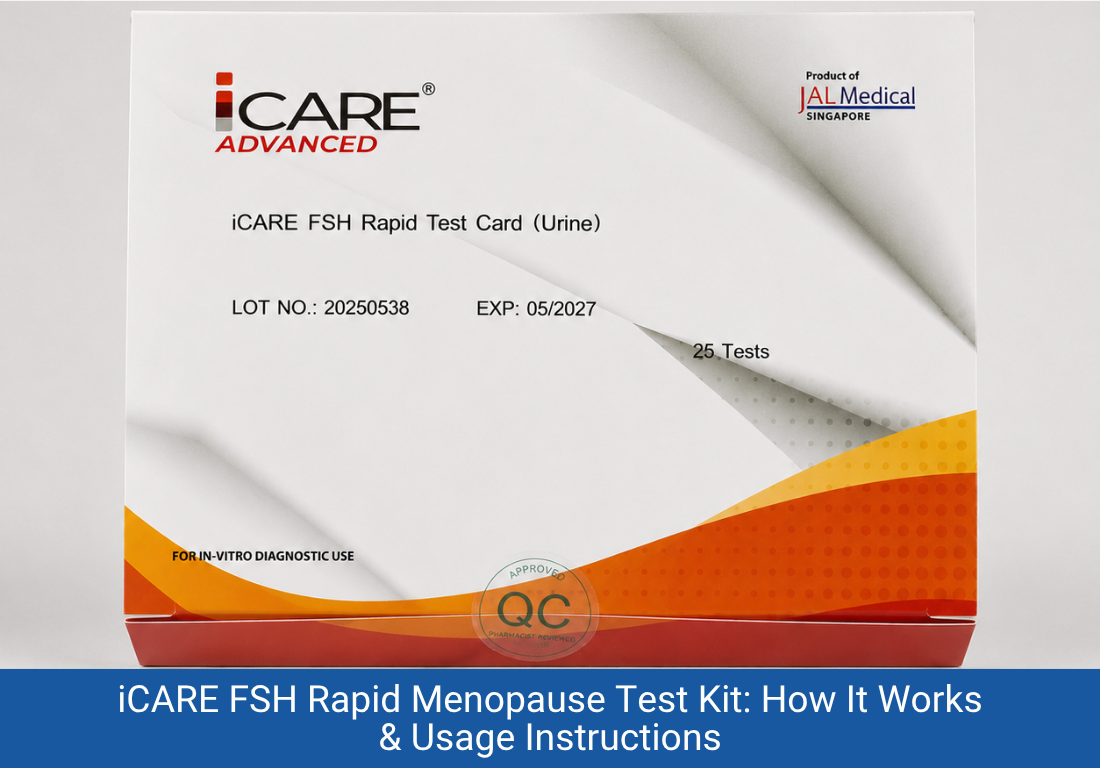
When FSH reaches the kit’s stated cutoff of 25 mIU/ml, a colored test band appears that is equal to or darker than the control band. Its instructions call for reading the result at 5 minutes and not after 10 minutes.
First morning urine is recommended, since it typically carries the highest FSH concentration. Later urine may lead to a false negative. JAL Medical also lists a cassette format of the same test; its cutoff, timing, and storage should be checked against its own current instructions rather than assumed to match the midstream version.
FSH Menopause Test Kit vs Laboratory Hormone Testing
Laboratory FSH testing uses a blood sample, typically serum, processed through calibrated instruments in a quality-controlled laboratory. Results are reported as a numerical value with a reference range, interpreted alongside symptoms and other findings.
A rapid urine test instead gives a qualitative, cutoff-based result at or near the point of care. It requires no laboratory equipment and provides a result within minutes. Both approaches measure the same hormone, but neither establishes a menopause diagnosis alone.
| Approach | Specimen or Information Used | Result Type | Typical Setting | Practical Value | Main Limitation |
| Rapid FSH test | Urine | Qualitative, cutoff based | Home or point of care | Fast initial screening | Cannot confirm menopause alone |
| Laboratory FSH test | Blood serum | Numerical, with reference range | Clinical laboratory | Objective, repeatable measurement | Needs collection and processing time |
| Clinician led assessment | Symptoms, menstrual history, age, exam | Clinical judgment | Clinic or consultation | Places any FSH result in context | Depends on information available |
Home Testing vs Point of Care Testing
The midstream format is described as an in vitro self test, meant for a person to collect their own specimen and interpret the result without a trained operator. JAL Medical’s cassette format is positioned toward clinic or hospital use rather than home self testing.
Point of care testing takes place under professional supervision, typically with operator training and quality control checks. Authorisation for home use does not automatically extend to point of care use, or the reverse. Clinics and distributors should verify which format is permitted for professional use in the target market before offering it that way.
Benefits and Limits of the Rapid FSH Test Kit
The rapid FSH test kit needs minimal equipment and returns a result within minutes, using only a urine sample. This makes it practical where a blood draw or nearby laboratory access is not straightforward.
Its main limits are that results are qualitative rather than numerical, and hormonal contraceptives, hormone therapy, or certain conditions can affect accuracy. A rapid result also cannot confirm menopause, determine fertility, predict when periods will stop, or explain the cause of hot flushes or irregular bleeding.
Interpreting FSH Menopause Test Kit Results
A positive rapid FSH result shows that FSH has reached the kit’s cutoff. This may be consistent with reduced ovarian function, but it does not by itself confirm menopause or its stage.
Because FSH fluctuates, a positive reading is often repeated after several days. A positive result with ongoing regular periods is not necessarily contradictory. A negative result means FSH was below the cutoff at testing, but it does not rule out perimenopause, particularly if symptoms continue.
When to Consider an FSH Hormone Test With a Professional
Healthcare professionals may consider further hormone evaluation when symptoms appear earlier than expected, when the clinical picture is unclear, or when symptoms could have another cause.
Evaluation may also be considered when hormonal medicines complicate interpretation, or when a numerical value is needed for the record. Routine hormone testing is not necessary for everyone with typical symptoms, and age related guidance applies to the population it was developed for, not as a universal rule.
| Question Being Asked | Approach That May Help |
| Is FSH currently elevated, as a first indication | Rapid FSH test |
| What is the exact FSH value | Laboratory FSH test |
| Are symptoms consistent with the menopause transition overall | Clinical assessment |
| Should testing be considered at an unusually early age | Referral for professional evaluation |
This table is a starting point for discussion, not a diagnostic rule.
Procurement Considerations for Clinics, Laboratories, and Distributors
Clinics, laboratories, and distributors evaluating a manufacturer such as JAL Medical should confirm intended use, authorised users, and the validated specimen type before ordering, and specify whether the midstream or cassette format is being supplied.
Performance evidence and result interpretation should be reviewed alongside training needs for staff who will perform or oversee testing. Storage conditions affect handling and inventory planning, while lot traceability supports ongoing reliability.
Buyers should also confirm which markets a given format is approved for, along with supply continuity from the FSH menopause test supplier.
 Call Us Now!
JAL Medical: FSH Test Kit Manufacturer
JAL Medical presents the iCARE FSH Menopause Test Kit as a qualitative urine self-test intended to detect FSH levels associated with menopause symptoms. The midstream format is supplied as a device with a desiccant and instructions for use.
Its storage guidance is 4°C to 30°C in the sealed pouch, away from direct sunlight, moisture, and heat, without freezing. JAL Medical also lists a cassette format, which may carry different storage, cutoff, or authorised use details and should be checked against its own current instructions.
As an FSH test kit manufacturer and FSH menopause test supplier, JAL Medical operates from Singapore. Clinics, laboratories, and distributors should confirm current specifications, authorised uses, and market approvals directly with JAL Medical for the exact format being ordered.
Conclusion
Rapid FSH testing, laboratory hormone testing, and clinician-led assessment each provide different information and serve different needs. Rapid testing offers speed and accessibility, laboratory testing offers a numerical value, and clinical assessment places either result within a fuller picture.
Neither a rapid nor a laboratory FSH result confirms menopause on its own. A clinician interprets symptoms and menstrual history in context, and the right combination depends on the clinical question being asked.
Frequently Asked Questions
What does an FSH Menopause Test Kit detect?
It detects follicle-stimulating hormone in urine, a hormone that commonly rises during the menopause transition. A result shows whether FSH has reached the kit's cutoff. It does not detect menopause directly.
Can an FSH hormone test confirm menopause?
No single FSH result, rapid or laboratory-based, can confirm menopause alone. FSH fluctuates during perimenopause, so one reading is not conclusive. Assessment considers symptoms, menstrual history, and age too.
How does a rapid FSH test differ from laboratory hormone testing?
A rapid FSH test uses urine and gives a qualitative, cutoff-based result within minutes. Laboratory testing uses blood and returns a numerical value with a reference range, interpreted by a clinician.
Why can FSH results vary between tests?
FSH levels change during the menstrual cycle and across the menopause transition, so results on different days can differ. A single reading is not conclusive, and retesting after several days is often suggested.
Can a negative FSH Menopause Test rule out perimenopause?
No. A negative result means FSH was below the kit's cutoff at testing, but FSH can rise later. Anyone with ongoing symptoms and a negative result should still consult a healthcare professional.
Is a home FSH self-test the same as point of care testing?
Not necessarily. JAL Medical's midstream format is meant for home self-testing, while its cassette format is positioned for clinic or hospital use. One authorisation does not cover the other.
When might a healthcare professional recommend further hormone evaluation?
Further evaluation may be considered when symptoms appear earlier than expected, when the clinical picture is unclear, or when another cause needs to be considered or a numerical value would help.
What should clinics and distributors check before purchasing FSH test kits?
Buyers should confirm intended use, authorised users, specimen type, cutoff, and performance evidence for the exact format, along with storage conditions and market approvals before ordering.