

Table of Contents
AI Summary:
An H. pylori stool antigen test kit detects H. pylori antigen in a fecal specimen and can provide a practical approach to stool-based testing. However, H. pylori test results can be affected by specimen collection, extraction, storage, testing conditions, reading time, antigen concentration, and clinical timing after treatment. Understanding these factors is important when evaluating H. pylori stool test accuracy, interpreting a false negative H. pylori test, and distinguishing valid negative results from invalid tests. Healthcare professionals and procurement teams should also review product specifications, reported performance, specimen requirements, storage conditions, documentation, and intended use before selecting a test.
What Is an H. pylori Stool Antigen Test Kit?
An H. pylori stool antigen test is designed to qualitatively detect H. pylori antigen in a human fecal specimen. Rapid formats can use a lateral flow chromatographic immunoassay, allowing results to be interpreted within a defined testing period.
The iCARE H. Pylori Antigen Rapid Test (Feces) is a lateral flow chromatographic immunoassay for qualitative detection of H. pylori antigen from human fecal specimens. Its stated result time is 15 to 20 minutes.
A stool test result depends not only on the assay but also on specimen collection, extraction, storage, testing, and interpretation. These factors are therefore relevant when assessing stool antigen test accuracy in routine use.
 Email Us Now!
What Affects H. pylori Stool Test Accuracy?
Several conditions can influence whether detectable H. pylori antigen is present in the portion of specimen tested and whether the assay produces an interpretable result.
Important considerations include specimen collection technique, specimen quantity, extraction, storage conditions, detectable antigen concentration, testing temperature, and adherence to the specified reading window.
For healthcare buyers, this means that a single sensitivity or specificity figure does not provide the complete basis for product selection. Specimen handling, workflow, storage, documentation, and intended use should also be evaluated.
How Specimen Collection Affects H. pylori Test Results
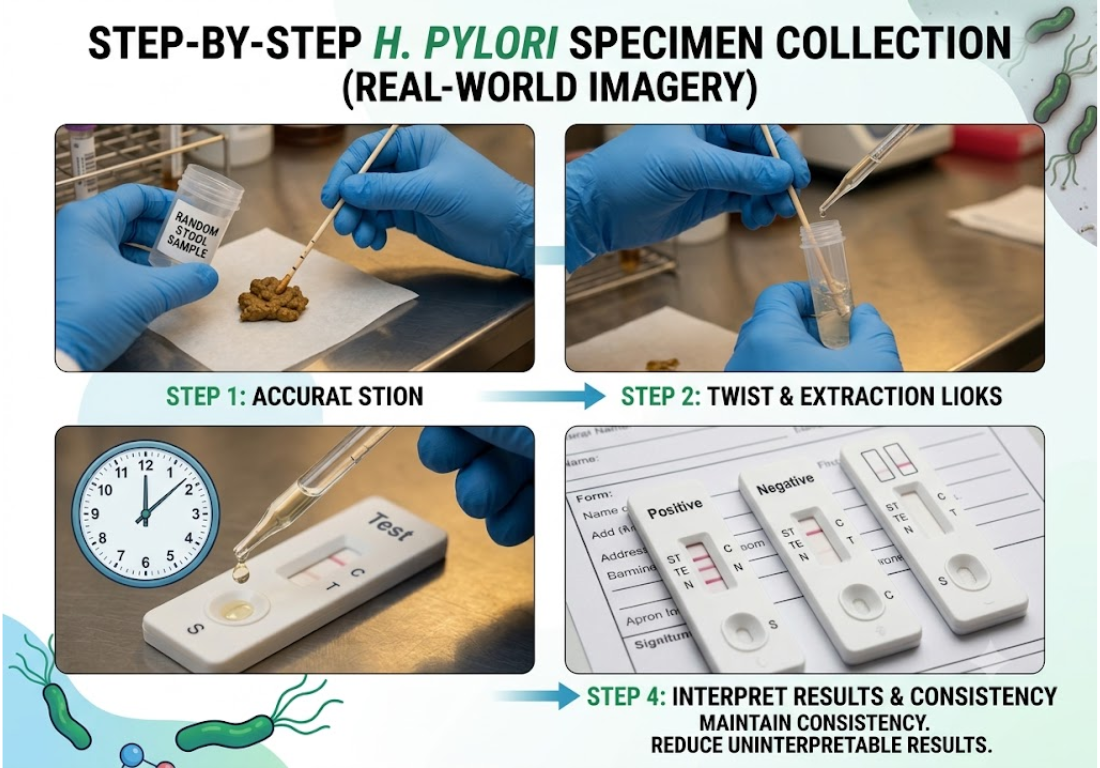
For the iCARE test, a random fecal specimen should be collected in a clean, dry container. The collection stick is inserted into the specimen at a minimum of five different sites, while excessive stool should not be scooped onto the stick.
The collection procedure is followed by preparation with the extraction tube. At the testing stage, two drops of extracted specimen, approximately 70 to 90 µL, are added to the specimen well.
Following the specified collection and application requirements helps maintain consistency between tests and reduces the risk of an uninterpretable result.
How Extraction and Storage Affect H. pylori Stool Test Accuracy
After specimen collection, the tube should be shaken vigorously so that the specimen is mixed with the extraction buffer. The prepared specimen can then be used according to the test procedure.
The unopened kit should be stored at 2 to 30°C, protected from sunlight, and should not be frozen. Extracted specimens can be stored at 2 to 8°C for up to three days. For longer storage, extracted specimens can be stored at minus 20°C or colder, with no more than three freeze and thaw cycles.
Before testing, the device and specimen should equilibrate to 15 to 30°C.
| Testing parameter | Requirement |
| Unopened kit | 2 to 30°C, protected from sunlight, do not freeze |
| Extracted specimen | 2 to 8°C for up to three days |
| Longer extracted specimen storage | Minus 20°C or colder, maximum three freeze and thaw cycles |
| Before testing | Equilibrate device and specimen to 15 to 30°C |
| Specimen applied | Two drops, approximately 70 to 90 µL |
H. pylori Test Reading Time and Result Interpretation
For the iCARE test, the extracted specimen is added to the specimen well and the timer is started. Results are interpreted within the specified 15 to 20 minute window.
Results should not be interpreted after 20 minutes. Maintaining a consistent reading period helps ensure that test lines are assessed within the procedure specified for the assay.
What Causes a False Negative H. pylori Test?
A false negative H. pylori test can occur when detectable antigen is not present at a sufficient level in the tested specimen or when testing conditions reduce the likelihood of detection.
One consideration is antigen concentration relative to the assay’s detection capability. Specimen handling and storage are also relevant because testing outside specified conditions can affect the prepared specimen.
Clinical timing after treatment is another important consideration. The American College of Gastroenterology recommends confirmation of H. pylori eradication at least four weeks after treatment. For appropriate post-treatment testing, PPIs should generally be held for two weeks and antibiotics and bismuth for four weeks when clinically appropriate.
This clinical guidance should not be interpreted as a product-specific analytical interference claim. The iCARE product information does not establish a specific antibiotic or PPI interference profile.
A negative result indicates that detectable H. pylori antigen was not identified in the tested specimen. It should therefore be considered together with the clinical situation rather than automatically treated as definitive proof that infection is absent.
Invalid H. pylori Test Results and Control Line Failure
A negative result and an invalid result are not the same.
The control line indicates that the test has produced the required procedural control response. If the required control line does not appear, the result is invalid and should not be interpreted as either positive or negative.
The procedure should be reviewed and the test repeated using a new device according to the applicable instructions.
This distinction is important when reviewing H. pylori test results, because an invalid test does not provide an interpretable finding.
H. pylori Test Interference and Test Limitations
H. pylori test interference should be considered in relation to clinical testing conditions as well as assay limitations.
Antibiotics, bismuth, and acid suppressive therapy are relevant to the timing of post treatment H. pylori testing. However, the iCARE product information does not establish a specific analytical interference profile or medication waiting period. Appropriate clinical protocols should therefore be considered when determining testing timing.
The iCARE test is qualitative. It indicates whether detectable antigen is present rather than measuring the concentration of antigen in the specimen. Results should consequently be interpreted within the intended use and limitations of the assay.
H. pylori Stool Antigen Test Accuracy and Clinical Performance
The reported evaluation of the iCARE H. Pylori Antigen Rapid Test included 309 fecal specimens and used a commercial urea breath test as the comparator.
| Parameter | Reported result |
| Test type | Lateral flow chromatographic immunoassay |
| Specimen | Human fecal specimen |
| Sensitivity | 97.22% |
| Specificity | 98.00% |
| Accuracy | 97.73% |
| Limit of detection | 1.0 ng/mL H. pylori lysate antigen |
| Evaluation specimens | 309 fecal specimens |
| Comparator | Commercial urea breath test |
| Result time | 15 to 20 minutes |
The reported performance reflects the evaluation conditions and should be considered in the context of the tested specimens and comparator method.
How to Choose the Best H. pylori Stool Antigen Test
Healthcare buyers evaluating an H. pylori stool antigen test kit should review technical information alongside operational requirements.
Key considerations include:
- Intended use
- Specimen type and collection requirements
- Required specimen volume
- Extraction procedure
- Storage conditions for the unused kit and extracted specimen
- Defined result reading window
- Available sensitivity, specificity, accuracy, and detection data
- Comparator method used for performance evaluation
- Instructions for use and technical documentation
- Suitability for the intended healthcare or laboratory setting
The Best H. Pylori Stool Antigen Test for a particular procurement program should therefore be assessed against the buyer’s actual requirements rather than selected on the basis of one performance number.
 Call Now!
JAL Medical H. pylori Stool Antigen Test Kit
JAL Medical manufactures and supplies the iCARE H. Pylori Antigen Rapid Test (Feces), a lateral flow chromatographic immunoassay for qualitative detection of H. pylori antigen in human fecal specimens.
For procurement teams, relevant considerations include the fecal specimen requirement, specimen preparation procedure, defined result window, storage conditions, intended use, and available technical information.
Key Factors Affecting H. pylori Test Results
Reliable H. pylori stool testing depends on more than the assay itself. Correct specimen handling, extraction, storage, testing conditions, and reading time all matter. Clinical timing after treatment should also follow appropriate guidance.
For procurement, buyers should assess intended use, workflow, storage, documentation, and reported performance together. A negative result should be interpreted within the limitations of antigen detection, while an invalid result should not be treated as a negative finding.
Frequently Asked Questions About H. pylori Stool Antigen Tests
What is an H. pylori stool antigen test used for?
An H. pylori stool antigen test qualitatively detects H. pylori antigen in a fecal specimen. Its interpretation depends on the intended use of the assay and the relevant clinical context.
What can affect H. pylori stool test accuracy?
Factors include specimen collection, specimen quantity, extraction, storage, antigen concentration, testing conditions, and reading time. Clinical timing after treatment can also affect detection.
What can cause a false negative H. pylori test?
A false negative may occur when detectable antigen is below the assay's detection capability or when specimen handling and clinical testing conditions reduce the likelihood of detection. Testing too soon after treatment is also an important consideration.
How long after H. pylori treatment should testing be performed?
For confirmation of eradication, current ACG guidance recommends testing at least four weeks after treatment. PPIs should generally be held for two weeks and antibiotics and bismuth for four weeks when clinically appropriate.
How should an extracted specimen be stored?
For the iCARE test, extracted specimen can be stored at 2 to 8°C for up to three days. For longer storage, it can be stored at minus 20°C or colder, with no more than three freeze and thaw cycles.
What does an invalid H. pylori test result mean?
An invalid result means the required control response was not produced. It should not be interpreted as negative. The procedure should be reviewed and the test repeated with a new device.
How should healthcare buyers evaluate an H. pylori stool antigen test kit?
Buyers should review intended use, specimen requirements, extraction procedure, storage conditions, reading time, technical documentation, and reported performance. The comparator method and evaluation conditions are also relevant.
How long does an H. pylori stool antigen rapid test take?
The iCARE H. Pylori Antigen Rapid Test has a stated result time of 15 to 20 minutes. Results should be interpreted within the specified reading window and not after the 20 minute limit.