

Table of Contents
AI Summary
A Hantavirus rapid test is a lateral flow immunoassay designed to detect and differentiate Hantavirus IgG and IgM antibodies in human whole blood, serum, or plasma specimens. A membrane strip with two capture zones lets laboratories distinguish a recent IgM response from a later IgG response within a short testing window. Because antibody patterns must be weighed alongside patient history and additional Hantavirus diagnostic test findings, results are preliminary rather than conclusive. Trained healthcare professionals use the assay as one part of a broader diagnostic workflow, supporting rather than replacing clinical judgment and further laboratory evaluation.
Understanding the Hantavirus Rapid Test and When It Is Used
Patients exposed to rodents or their waste products can develop symptoms resembling influenza or other febrile illnesses, so clinical presentation alone cannot confirm infection. Laboratories rely on a Hantavirus rapid test to support early evaluation, particularly when confirmatory laboratory turnaround is not immediately available.
This guide explains the Hantavirus test procedure, including preparation, specimen handling, test operation, result interpretation, and common errors. The Hantavirus Rapid Test Kit offers preliminary information meant to guide, not replace, clinical judgment.
 Email Us
What Does the Hantavirus IgG IgM Rapid Test Detect?
The assay qualitatively detects and differentiates Hantavirus IgG and IgM antibodies rather than the virus itself, distinguishing it from antigen-based and molecular methods. The Hantavirus IgG IgM rapid test provides qualitative antibody findings that must be interpreted alongside symptom onset, exposure history, and additional laboratory evidence.
IgM reactivity may support evidence of a recent immune response, while IgG can be associated with current or previous exposure; neither pattern alone determines the exact stage of infection. The CDC notes that hantavirus diagnosis commonly relies on serology, interpreted alongside compatible illness and exposure history (CDC, cdc.gov/hantavirus/hcp/clinical-overview/hps.html). Line intensity does not correlate with antibody concentration or severity.
How Does a Hantavirus Rapid Test Kit Work?
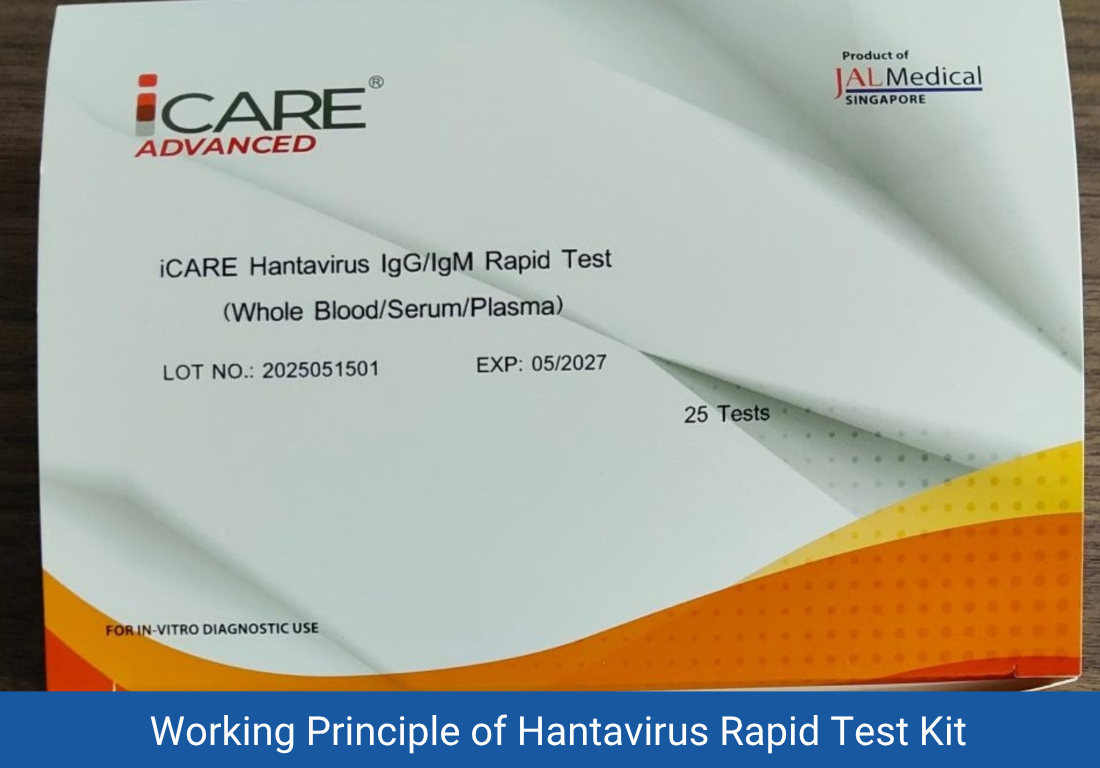
The kit works on a lateral flow chromatographic principle. The specimen is placed in the sample well, and diluent is added to an adjacent well to carry the sample across a membrane strip.
As it migrates by capillary action, Hantavirus antibodies at or above the detection threshold bind to recombinant antigens conjugated with colloidal gold, and the complexes are captured at dedicated zones: IgM at the M region and IgG at the G region. A control zone, marked C, captures conjugate regardless of antibody status, confirming the device functioned correctly.
Materials Needed for the Hantavirus Rapid Test Kit
Materials provided: individually foil-pouched test device with desiccant, sample diluent, a specimen dropper of approximately 10 microlitre capacity, and a package insert.
Optional materials: blood lancet and alcohol pad.
Required but not provided: timer, specimen collection containers, personal protective equipment, and a biohazard waste container.
Preparing for the Hantavirus Test Procedure
The steps summarized here reflect the manufacturer’s instructions for use and are intended for trained healthcare professionals. The instructions supplied with the specific kit lot and applicable laboratory procedures must always take precedence.
Confirm the correct test and specimen identity, verify the expiration date, and examine the pouch for damage. Allow the device, diluent, and specimen to reach room temperature, then gently shake the diluent. Prepare a clean, level surface, have a timer ready, label the device with the specimen identification number, and wear appropriate protective equipment. Recommended testing conditions are 15°C to 30°C.
Specimen Collection for Hantavirus Diagnostic Testing
Treat all human-derived specimens as potentially infectious and handle them under standard biosafety procedures.
Whole blood may be obtained by fingerstick or venipuncture using EDTA, citrate, or heparin. Hemolysed or frozen blood must not be used. If delayed, refrigerate between 2°C and 8°C and test within 24 hours.
Serum and plasma should be tested promptly, or stored between 2°C and 8°C for up to three days, or frozen at minus 20°C for longer storage, limiting freeze and thaw cycles to three. Specimens showing gross lipaemia, hemolysis, or turbidity should not be used.
Step-by-Step Hantavirus Test Procedure
Step One, Prepare the device: Remove the device from its sealed pouch immediately before testing, place it on a clean, level surface, and label it with the specimen identification number.
Step Two, Prepare the specimen: Tear off the sealing film of the buffer tube. Fill the pipette dropper with the specimen. Hold the dropper vertically and transfer one full drop of whole blood/serum/plasma specimen (10μL) into the buffer tube. Install the dripper of the tube. Shake the buffer tube vigorously to mix the sample well.
Step Three, Add the specimen: Hold the buffer tube vertically and add 2 drops of specimens into the specimen well (S) making sure that there are no air bubbles.
Step Four, Start the timer: Begin timing once the specimen and diluent are added.
Step Five, Read the result: Read reactive results from 15 minutes. Confirm apparently nonreactive results at 20 minutes, and do not interpret the device after 20 minutes.
Step Six, Record and dispose: Record the result per laboratory procedure and dispose of the device in a biohazard container per applicable regulations.
How to Read Hantavirus IgG and IgM Results
The control line must appear before any result can be considered interpretable.
| Visible lines | Result category | Practical interpretation |
| C and M lines | IgM reactive | Hantavirus IgM antibodies were detected |
| C and G lines | IgG reactive | Hantavirus IgG antibodies were detected |
| C, G, and M lines | IgG and IgM reactive | Both antibody types were detected |
| C line only | Nonreactive | No IgG or IgM test line was detected |
| No C line | Invalid | Result cannot be interpreted; repeat with a new device |
A reactive result is preliminary. A nonreactive result does not automatically rule out infection; see Limitations for details. An invalid result differs from a nonreactive one and requires repeating with a new device.
Common Errors in the Hantavirus Test Procedure
Common errors include using an expired, damaged, or frozen kit; exposing it to excess heat; testing an unsupported or hemolysed specimen; adding an incorrect specimen; introducing air bubbles; touching the reaction area; mixing components from different lots; and misreading the timing window.
Quality Control for the Hantavirus IgG IgM Rapid Test
Internal control: The C line confirms the device functioned and sufficient specimen migrated through the membrane, not that the specimen was ideally collected or stored.
External control: Positive and negative controls are not supplied; testing them periodically is recommended as good laboratory practice.
Storage and Handling of the Hantavirus Rapid Test Kit
- Store between 2°C and 30°C, away from direct sunlight; never freeze the kit or expose it above 30°C
- Documented shelf life is 24 months from the date of manufacture; check the expiration date before use
- Bring components to 15°C to 30°C before testing and use the device immediately after opening its pouch
- Do not use damaged devices or mix components from different lots
Limitations of the Hantavirus Diagnostic Test
The test provides qualitative antibody detection, not a measure of concentration, and must not serve as the sole criterion for diagnosis. A nonreactive result may occur when antibody levels fall below the detection limit or are not yet present at the stage of illness when the specimen was collected; a nonreactive result at any time does not preclude Hantavirus infection.
The test cannot confirm the Hantavirus genotype. Heterophile antibodies, rheumatoid factor, or improperly stored whole blood may affect results; a serum or plasma specimen can be substituted.
Hantavirus Rapid Test Versus Molecular Testing
| Factor | Rapid IgG and IgM test | Molecular test |
| Detection target | Hantavirus IgG and IgM antibodies | Viral genetic material |
| Result type | Qualitative antibody reactivity | Molecular evidence |
| Testing role | Screening and diagnostic support | Direct detection |
| Equipment | No instrument required for the cassette | Specialized laboratory systems |
| Interpretation | Needs clinical and epidemiological context | Needs laboratory interpretation |
Neither method is universally superior; selection depends on testing purpose and laboratory infrastructure.
Reported Clinical Performance of the Hantavirus IgG IgM Rapid Test
The Hantavirus IgG IgM rapid test has been evaluated against a reference commercial ELISA using clinical specimens; the specific ELISA method and insert version are not named in the available documentation, and the evaluation is manufacturer-reported rather than independently confirmed.
| Test marker | Specimens evaluated | Positive percent agreement | Negative percent agreement | Overall percent agreement |
| IgG | 246 total; 26 positive, 220 negative | 96.15 percent (81.11 to 99.32 percent) | 99.54 percent (97.47 to 99.92 percent) | 99.18 percent (97.08 to 99.78 percent) |
| IgM | 230 total; 30 positive, 200 negative | 93.33 percent (78.68 to 98.15 percent) | 99.50 percent (97.22 to 99.91 percent) | 98.69 percent (96.24 to 99.56 percent) |
These are manufacturer-reported findings and may not predict every result across every population or specimen condition.
JAL Medical as a Hantavirus Test Kit Manufacturer and Supplier
JAL Medical serves as a Hantavirus Test Kit Manufacturer supporting institutional buyers evaluating Hantavirus testing solutions, with the 25 tests per kit format suited to predictable laboratory batch sizes.
Organizations can contact JAL Medical, acting as a Hantavirus Test Kit Supplier, to confirm pack sizes, bulk order terms, export documentation, distributor arrangements, and any OEM or private label options; regulatory suitability should be verified separately for each destination market.
 Call Now
When Is Additional Testing Necessary After a Hantavirus Rapid Test?
Further evaluation may be appropriate when a result is reactive, when it is nonreactive but suspicion remains, or when testing occurs before detectable antibodies have developed.
Persistent symptoms, a meaningful exposure history, a missing control line, or clinical findings that do not align with the result are additional reasons to pursue further testing.
Conclusion
The Hantavirus rapid test offers a practical, membrane-based method for detecting and differentiating Hantavirus IgG and IgM antibodies in whole blood, serum, or plasma. Correct specimen preparation, accurate volumes, and adherence to the reading window affect reliability, as does confirming the control line before interpretation. Because results are preliminary, further clinical or laboratory evaluation may still be needed.
Frequently Asked Questions
Is the Hantavirus rapid test kit intended for professional use?
Yes. The Hantavirus IgG IgM rapid test kit is a professional in vitro diagnostic intended for trained healthcare professionals following the manufacturer's instructions for use, not for home or patient self-testing.
Can components from different Hantavirus test kit lots be combined?
No. Components from different kit lots may not be interchangeable. Use only the device, diluent, and supplied accessories assigned to the same lot, according to the manufacturer's instructions.
What documentation and regulatory checks should buyers complete before ordering?
Buyers should request the package insert, specification sheets, and applicable certificates from JAL Medical, then confirm registration, import permit, or certification requirements with their local regulatory authority, since status varies by destination market.
What quality certifications support JAL Medical as a Hantavirus Test Kit Manufacturer?
JAL Medical states that its manufacturing systems follow relevant quality management requirements.
Can JAL Medical supply Hantavirus test kits in bulk?
Contact JAL Medical, a Hantavirus Test Kit Manufacturer and Supplier, to confirm bulk and wholesale order terms, pack sizes, minimum quantities, and lead times, since standard availability should not be assumed without direct verification.
Are OEM or private label supply options available for the Hantavirus rapid test kit?
OEM and private label arrangements can be discussed directly with JAL Medical. Availability, branding terms, and documentation should be confirmed for this specific kit, since terms may vary by product and destination market.