

Table of Contents
AI Summary:
A Typhoid IgG+IgM Test Kit and a typhoid antigen test answer different diagnostic questions because they measure different biological markers. The antibody kit is designed to detect IgG and IgM immune responses that may develop after exposure to Salmonella Typhi, while the antigen format is designed to detect bacterial components when supported by the manufacturer’s documentation. Specimen requirements, testing windows, and diagnostic roles can differ between the two formats. The most appropriate rapid testing method depends on the timing of illness, the intended clinical use, and the specific claims validated for the selected kit, rather than on one format being inherently preferred.
Typhoid Antibody Test vs Typhoid Antigen Test: Why They Differ
An antibody is a protein the immune system produces in response to infection, while an antigen is a component associated with the organism itself. A typhoid antibody test and an antigen-based test do not measure the same biological marker, so a result from one should not be read as equivalent to the other.
Blood culture remains the preferred method for diagnosing typhoid fever. A Typhoid rapid test, whether antibody-based or antigen-based, should be interpreted according to its validated intended use and alongside clinical findings and other laboratory evidence rather than used alone to confirm or exclude infection.
Timing of collection, stage of illness, and specimen type can all influence whether either marker is detectable. This is why laboratories weigh a Typhoid diagnostic test format, and a specific rapid typhoid test kit, against the clinical question being asked before choosing a testing pathway.
 Email Us Now!
What Does a Typhoid IgG+IgM Test Kit Detect?
A Typhoid IgG+IgM Rapid Test is designed to detect IgG and IgM antibodies associated with the immune response to S. Typhi, where supported by the official documentation for the selected kit. IgM may be associated with an earlier immune response, while IgG may appear later or persist longer, and this timing varies between individuals.
A reactive IgG result does not automatically confirm current infection, and a reactive IgM result does not independently confirm acute illness. Line intensity should not be read as antibody quantity or disease severity unless documentation states otherwise.
What Does a Typhoid Antigen Test Detect?
A Typhi antigen test is designed to detect bacterial components rather than an immune response. Whether a kit detects S. Typhi alone, or S. Typhi together with S. Paratyphi, depends entirely on its validated claims and should be confirmed rather than assumed.
Laboratories should also confirm the accepted specimen and whether a reactive result is preliminary pending further evaluation, since these details vary between manufacturers and should never be transferred from one kit to another.
Typhoid Antibody Test and Antigen Test Compared
| Comparison factor | Typhoid IgG+IgM test kit | Typhoid antigen test |
| Detection target | IgG and IgM antibodies | S. Typhi or supported antigens |
| Biological meaning | Immune response | Organism component |
| Test principle | As documented | As documented |
| Specimen | Officially validated only | Officially validated only |
| Timing | Depends on antibody development | Depends on antigen presence |
| Result categories | May differentiate IgG and IgM | Depends on included targets |
| Diagnostic role | Screening or support, as documented | Screening or support, as documented |
| Key limitation | May not reflect infection stage | May not be detectable at every stage |
| Additional testing | May be required | May be required |
Interpreting Typhoid IgG and IgM Antibody Test Results
A Typhoid IgG+IgM Rapid Test typically reports reactivity for IgM, IgG, both, or neither, alongside a control line confirming the test ran correctly. An invalid result, usually a missing or unclear control line, calls for retesting rather than interpretation.
A nonreactive result does not always exclude typhoid fever, particularly if collection occurred before a detectable response developed. Results are meant to be evaluated alongside symptoms and history rather than read in isolation.
Typhi and Paratyphi Antigen Test Targets
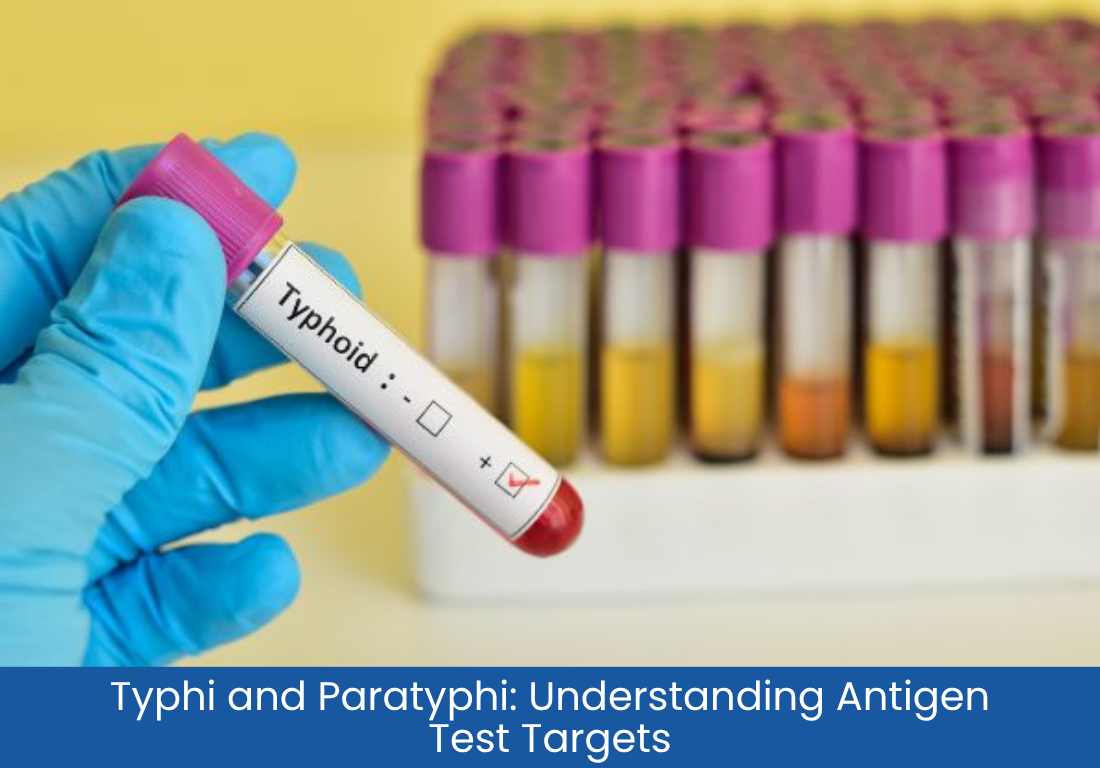
Typhoid fever is caused by the bacterium Salmonella enterica serovar Typhi, commonly written as Salmonella Typhi or S. Typhi. Paratyphoid fever is a related but distinct illness associated with Salmonella Paratyphi serovars, and the two are often grouped under the broader clinical term enteric fever.
Because the organisms are related but not identical, an antigen test validated for S. Typhi should not be assumed to also detect S. Paratyphi. Before adopting any antigen kit, providers should verify which targets are included and whether they are reported on separate or combined lines.
Specimen Requirements for Antibody and Antigen Testing
The specimen accepted by a rapid test depends entirely on how that kit was designed and validated, and should be confirmed from its instructions for use. Relevant details include specimen type, collection method, preparation, required volume, storage, transport, and rejected specimen conditions.
Performance shown with one specimen type cannot be extended to another, so antibody and antigen kits should each be evaluated against their own validated specimen list.
Timing and the Typhoid Rapid Test Result
The stage of illness at collection can influence antibody and antigen detection differently. Antibodies generally take time to develop after exposure, so testing very early may occur before a detectable response has formed. Antigen availability may change as infection progresses.
Typhoid Rapid Test Procedures and Result Reading
Procedural steps, specimen volume, timing, the reading window, and control line design vary by manufacturer and product line, and should be confirmed from each kit’s instructions for use rather than assumed to match across formats. Results read outside the documented window may not reflect the intended interpretation criteria.
Advantages of the Typhoid IgG+IgM Test Kit and Antigen Test
A Typhoid IgG+IgM Test Kit may support separate evaluation of IgG and IgM reactivity where documented, offering rapid antibody information within a broader serological workflow. A typhoid antigen test can offer direct evaluation of the target it was designed for.
Neither format is universally faster, earlier, or more accurate; suitability depends on intended use and documented performance.
Limitations of Typhoid Antibody and Antigen Testing
Antibody test limitations: Antibodies may not be detectable at every stage of illness, and IgG and IgM patterns require clinical interpretation. Prior exposure and cross-reactivity may influence results, and the test does not directly identify bacterial antigen.
Antigen test limitations: Antigen levels may vary during illness, and specimen selection or handling may affect detection. The test detects only the targets included in its design, so Typhi detection does not imply Paratyphi detection.
Typhoid Diagnostic Test Options Beyond Rapid Testing
Rapid antibody and antigen tests are typically used within a broader diagnostic process rather than as a standalone conclusion. Blood culture is the recognized reference method for confirming S. Typhi infection, and molecular testing or laboratory-based serology may complement rapid formats in certain workflows.
Selection among methods depends on stage of illness, specimen availability, laboratory infrastructure, prior antimicrobial exposure, and applicable clinical guidance.
Which Typhoid Rapid Test Kit Is More Appropriate?
| Testing consideration | What to evaluate |
| Assess antibody response | An officially documented IgG and IgM test |
| Detect bacterial antigen | An appropriate antigen test |
| Evaluate Typhi and Paratyphi | Confirm exactly which targets are detected |
| Available specimen | A test validated for that specimen |
| Early or later testing context | How antigen and antibody availability may differ |
| Laboratory confirmation needed | Follow the applicable diagnostic protocol |
| Limited infrastructure | Confirm the workflow is validated and practical |
| Procurement decision | Review performance, controls, storage, and documentation |
The appropriate option depends on the clinical question, the detection target required, the available specimen, the timing of testing, and the intended use, rather than on one format being generally superior.
Procurement Checklist for a Rapid Typhoid Test Kit
Before selecting a rapid typhoid test kit, institutions and distributors should review intended use, detection target, supported specimens, sensitivity and specificity, comparator method, study size, control design, cross-reactivity, and interference data. Storage conditions, shelf life, pack size, regulatory status, quality documentation, lot traceability, and supply continuity should also be confirmed.
 Call Now!
JAL Medical: Typhoid IgG+IgM Rapid Test Kit Manufacturer
JAL Medical is a Singapore-based in vitro diagnostic manufacturer and exporter under the iCARE Advanced brand, with manufacturing in Taiwan and China and distribution across more than 65 countries. As a Typhoid IgG+IgM Rapid Test Kit manufacturer, JAL Medical offers both a Typhoid IgG+IgM Rapid Test and a Typhi antigen test, each with its own defined detection target and supported specimen.
The company supports bulk supply, OEM and private-label programs, and export and registration assistance. Importers are encouraged to request the relevant instructions for use directly.
Conclusion
A Typhoid IgG+IgM Test Kit and a typhoid antigen test serve different diagnostic roles because they measure different biological markers. Choosing between them depends on the detection target required, the available specimen, the timing of testing, and the documented performance of the kit under review.
Frequently Asked Questions
What is the main difference between a Typhoid IgG+IgM Test Kit and an antigen test?
A Typhoid IgG+IgM Test Kit detects antibodies the immune system may produce in response to S. Typhi, while an antigen test detects bacterial components directly. The two formats measure different biological markers.
What does a Typhoid antibody test detect?
It detects IgG and IgM antibodies associated with the immune response following possible exposure to S. Typhi. IgM may reflect an earlier response stage while IgG may appear later or persist longer.
What does a Typhi antigen test detect?
A Typhi antigen test detects bacterial antigen associated with S. Typhi rather than an antibody response. The specific target and accepted specimen depend on the validated claims for the selected product.
Can an antigen test detect both Typhi and Paratyphi?
Some antigen tests may be validated for both S. Typhi and S. Paratyphi, while others detect only S. Typhi. Coverage varies by product and should be confirmed before assuming broader coverage.
Do antibody and antigen tests use the same specimens?
Not necessarily. Each rapid test is validated against specific specimen types described in its instructions for use, and performance shown with one specimen cannot be assumed for another.
What do IgG and IgM results mean?
IgM reactivity may suggest an earlier immune response, while IgG reactivity may reflect a later or persisting response. Combined results require interpretation alongside symptoms and history.
Can a nonreactive rapid test exclude typhoid fever?
No. A nonreactive result does not always exclude infection, particularly if collected before a detectable marker was present. Persistent clinical suspicion warrants further evaluation, including blood culture.
Which test is more suitable during early infection?
Suitability depends on how quickly antibodies develop compared with antigen availability in the specimen, and this can vary. Intended use and documented performance should guide selection.
Can a rapid test replace blood culture or molecular testing?
No. Rapid antibody and antigen tests are used within a broader diagnostic process, and blood culture remains the preferred diagnostic method for confirming typhoid fever.
What should healthcare providers check before buying a rapid typhoid test kit?
Buyers should review intended use, detection target, validated specimens, sensitivity and specificity data, storage conditions, shelf life, and regulatory documentation, along with supply continuity and training support.