

Table of Contents
AI Summary:
An Ebola virus test kit is a diagnostic product used to detect evidence of Ebola virus infection in a clinical specimen. This guide explains how an Ebola rapid test kit compares with laboratory-based molecular testing and what an Ebola antigen test measures. It also covers specimen timing, result interpretation, screening applications, and important selection factors. The objective is to help clinical, laboratory and procurement teams evaluate available testing methods according to their authorized intended use.
Ebola Virus Test Kit Overview
Clinicians, laboratories, public health teams, and procurement professionals can use the sections below to evaluate the available approaches to Ebola testing, covering detection targets, specimen timing, result interpretation, screening applications and selection factors, and clarifying where rapid methods fit alongside laboratory confirmation.
 Email Us Now!
What Is Ebola Virus Disease?
Ebola virus disease is caused by viruses belonging to the genus Orthoebolavirus. It can affect multiple organ systems and may progress to serious complications. Transmission generally occurs through direct contact with infected blood or other body fluids, requiring coordinated clinical and public health measures during an outbreak.
Early symptoms, including fever, fatigue, and gastrointestinal illness, are nonspecific and overlap with several other infectious diseases common in the same regions. Because clinical presentation alone cannot reliably distinguish Ebola virus disease from these other conditions, laboratory testing is required to confirm infection, while a negative result must be interpreted according to specimen timing, exposure history, and the applicable testing protocol.
Why Does Early Ebola Diagnostic Testing Matter?
Timing affects several distinct functions once Ebola virus disease is suspected. An early result can support case investigation and help public health teams begin contact tracing and exposure assessment sooner. Timing also drives infection control decisions inside a facility, including isolation of the suspected patient and protection of staff and other patients while an evaluation is underway.
At a public health level, an early result shapes how quickly a response team can be mobilized and how resources are allocated across an affected area. This is why turnaround time is treated as a practical decision factor, not just a technical specification, when a testing method is selected for a specific setting.
How Does Ebola Diagnostic Testing Work?
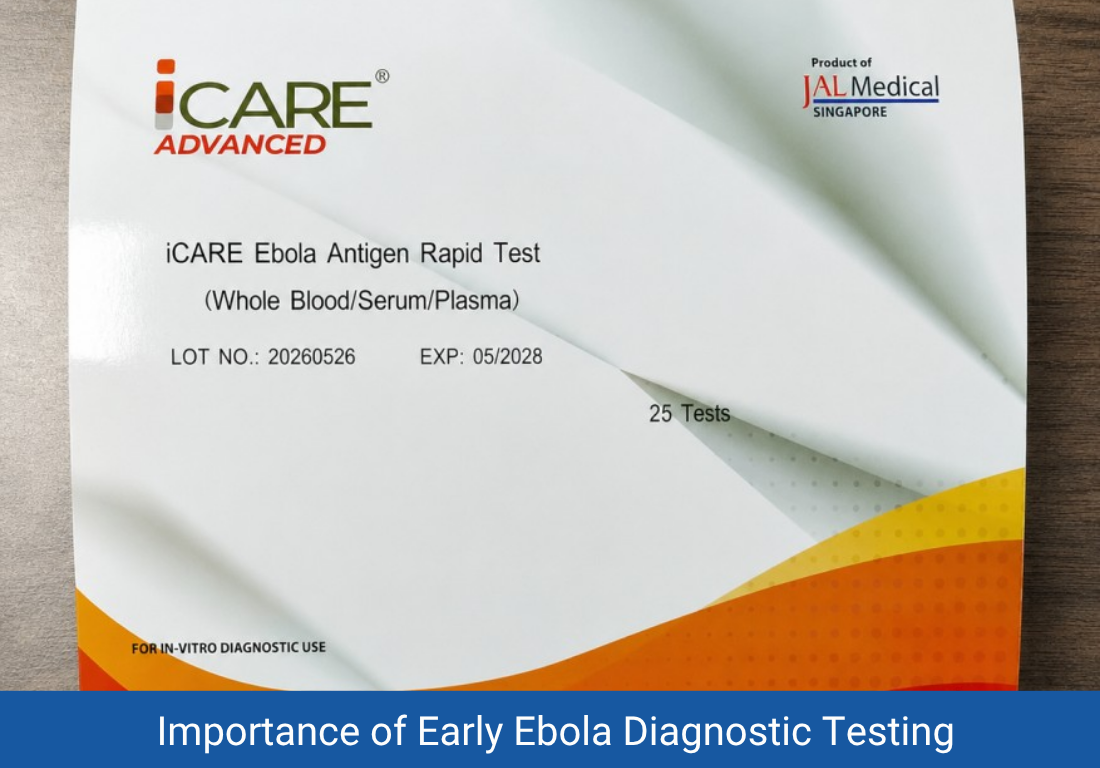
Ebola diagnostic testing can detect two different biological targets, and this choice is the fundamental distinction between test types. Antigen-based approaches identify specific viral proteins present in a clinical specimen, usually blood. Molecular methods instead detect and amplify viral genetic material, confirming the presence of the virus through a different biological signal entirely.
The detection target matters because it determines what a test is actually measuring, how it should be used, and how confident a given result can be considered on its own. This distinction provides the basis for evaluating test performance, result interpretation, and the need for laboratory confirmation.
What Is an Ebola Virus Test Kit?
An Ebola virus test kit refers, in practical terms, to a diagnostic product designed to detect evidence of Ebola virus infection, with the specific technology and intended use varying by product. Not every Ebola test kit on the market uses the same underlying detection method, specimen type, or equipment, so none of these details should be assumed from one product to another.
Before relying on any specific Ebola virus test kit, a laboratory or healthcare institution should verify the details covered in the selection framework below, including its intended use, specimen type, equipment needs, and regulatory status, directly against that product’s official documentation.
What Is an Ebola Antigen Test?
An Ebola antigen test is designed to detect specific viral proteins present in a clinical specimen, produced by the virus itself, which is why their presence can indicate active infection. This is distinct from the genetic material that a molecular test looks for, as covered in the previous section.
An antigen result is generally treated as presumptive rather than final. Public health guidance typically calls for a reactive antigen result to be confirmed by molecular testing according to the applicable protocol, since antigen detection alone does not carry the same evidentiary weight as a molecular confirmation.
How Specimen Timing Affects Ebola Test Results
The timing of specimen collection relative to symptom onset can affect Ebola test results. The validated testing window, sensitivity at different stages of illness, and need for repeat testing vary according to the assay, specimen type, and applicable public health protocol.
This is one reason a single negative result does not automatically exclude infection, particularly when exposure risk or clinical suspicion remains. A specimen collected outside the test’s validated detection window may not reflect the same result as one collected during the period the test was validated for. Depending on the applicable protocol, repeat testing at a later point is a common response to this kind of timing uncertainty rather than a sign that the original test failed.
Our Other Product
Drug of Abuse Rapid Screen TestsHow Does an Ebola Rapid Test Kit Work?
The mechanism behind a rapid antigen test follows a consistent sequence. A specimen is applied to the test device, where it interacts with reagents designed to bind to the target viral protein. If the target is present in sufficient quantity, this interaction produces a visible signal, typically a colored line, within a defined reading window.
Most formats also include a separate control line intended to confirm that the specimen migrated correctly and that the reagents functioned as expected. A missing or unclear control line generally makes the result invalid rather than negative. Because the timing of the reading window and the interpretation criteria vary between products, results should always be read according to the instructions for that exact test.
Rapid Ebola Testing vs Laboratory Testing
| Factor | Rapid antigen testing | Laboratory molecular testing |
| Target | Specific viral antigens | Viral genetic material |
| Typical role | Preliminary or presumptive assessment | Laboratory confirmation |
| Equipment | Usually limited, depending on the product | Molecular testing equipment and trained personnel |
| Result time | Usually shorter | Depends on transport and laboratory workflow |
| Confirmation | Reactive results may require molecular confirmation | Interpreted under the applicable laboratory protocol |
All entries above must still be checked against the documentation of the particular product being discussed. Rapid testing and laboratory testing generally serve different roles within the same diagnostic pathway: a rapid result supports fast initial decisions, while laboratory based molecular testing typically remains central to confirming a diagnosis.
Where Can Rapid Ebola Testing Support Screening?
Rapid testing tends to fit into a handful of specific operational settings rather than every point in a diagnostic pathway. Initial assessment workflows are one example, where a rapid result helps a clinician sort patients quickly at first contact, before laboratory results are back.
Outbreak response is another. Mobile or community based teams working in areas with limited laboratory access may use a rapid test to flag suspected symptomatic cases for further evaluation and transport, since waiting for centralized laboratory results is often not practical in the field. Individuals identified through contact monitoring who go on to develop symptoms consistent with the case definition may also be assessed this way, subject to the applicable public health protocol governing that specific use. Routine testing of asymptomatic contacts is a different question, governed by its own protocol rather than by a rapid test’s general availability.
What ties these settings together is that each one calls for information quickly, has appropriate biosafety arrangements in place for handling specimens outside a full laboratory, and uses a test strictly within its authorized and validated intended use.
Ebola Diagnostic Test Selection: What Organizations Should Consider
Screening, detection, and confirmation are related but distinct purposes, and a test validated for one is not automatically suitable for another. Whether a given rapid test can support screening, detection, or confirmation depends specifically on its authorized intended use and the diagnostic or public health protocol that applies in a given setting, not on the test format alone.
| Decision factor | What to consider |
| Detection target | Antigen or genetic material, depending on the selected method |
| Specimen | Whether the required specimen is available and appropriate |
| Intended use | Screening, detection, confirmation, or another defined purpose |
| Turnaround | Required reporting time |
| Infrastructure | Available equipment, personnel, and laboratory capabilities |
| Biosafety | Applicable biosafety requirements and institutional procedures |
| Interpretation | Requirements for reading and evaluating results |
| Confirmation | Whether additional laboratory testing is required |
| Quality control | Availability of appropriate controls and procedures |
| Procurement | Storage, packaging, supply continuity, and documentation requirements |
Purchasing decisions should be grounded in these factors, verified against a product’s own documentation, rather than in unsupported commercial claims about any single product.
JAL Medical and Ebola Diagnostic Testing
Selecting a supplier for an Ebola virus diagnostic test requires evaluating factors beyond a single product datasheet, including the manufacturer’s experience with in vitro diagnostics, quality management systems, documentation, and regulatory track record.
JAL Medical is a manufacturer of rapid diagnostic test kits with experience across several infectious disease categories. This background reflects manufacturing and regulatory experience in infectious disease rapid testing generally. It does not indicate that JAL Medical currently manufactures or supplies an Ebola-specific test kit, and any institution with an Ebola virus diagnostic test requirement should request the relevant product’s intended use statement, validation data, and regulatory status directly from the manufacturer before proceeding.
What Are the Limitations of Rapid Ebola Testing?
Rapid diagnostic tests carry limitations that must be weighed before clinical or institutional decisions are made. Performance can vary depending on the specific technology and specimen type involved, in addition to the specimen timing considerations already covered above.
Cross-reactivity with other pathogens is a further consideration, since some antigen based tests can produce misleading signals depending on their design and the population being tested. Storage and handling conditions can also affect performance: a test stored or transported outside its specified temperature range may not perform as validated, which is why documentation of storage requirements matters as much as the test itself. Personnel training is a final factor, since improper specimen collection or handling can affect any result regardless of how the test itself performs.
 Call Now!
What Happens After an Ebola Diagnostic Test Result?
A person meeting the applicable suspected case definition should already be managed under appropriate isolation and infection control procedures while testing is coordinated, rather than waiting for a result to trigger that response. A reactive rapid result then requires reporting and confirmatory action according to the relevant public health protocol.
A negative result does not automatically end monitoring if the person had a known exposure or if symptoms are still evolving, for the timing reasons already discussed. An invalid or uninterpretable result would typically call for the test to be repeated with a fresh specimen, following the correct procedure, subject to whatever the applicable protocol specifies for handling an invalid result.
Read our Article
Significance of WHO PQ Listed (Co-Branded) Rapid TestsWhich Ebola Diagnostic Method Is Better?
There is no single diagnostic method that is automatically the best choice for every testing situation. The appropriate approach depends on the detection target, the specimen available, the intended use, the stage of illness, the required turnaround time, the laboratory infrastructure on hand, biosafety requirements, the need for confirmation, and applicable public health requirements.
| Situation | Key consideration |
| Need for rapid preliminary information | Consider an appropriate rapid test where authorized and indicated |
| Need for molecular detection | Consider an appropriate molecular method |
| Need for laboratory confirmation | Use the method required by the relevant diagnostic or public health protocol |
| Limited laboratory infrastructure | Consider methods compatible with the available validated workflow |
| Persistent clinical or epidemiological concern | Consider whether additional testing is appropriate |
Ebola Virus Test Kit: Key Takeaways
An Ebola virus test kit is only as useful as the fit between its detection target, specimen requirements, and intended use, and the situation it is applied to. Rapid Ebola testing and laboratory-based molecular methods serve different roles within the same diagnostic pathway, so neither should be treated as a universal solution.
Ebola Virus Test Kit: Frequently Asked Questions
What documentation should buyers request before purchasing an Ebola test kit?
At minimum, the intended use statement, validation and performance data, specimen requirements, storage conditions, and current regulatory or public health approval status, all sourced directly from the manufacturer rather than inferred from similar products.
Does every rapid Ebola test detect the same virus species or strain?
No. Coverage varies by product design, and a kit validated against one species or strain is not automatically validated against others. Species and strain coverage should be confirmed in the specific product's documentation before selection.
How should Ebola test kits be stored and transported?
Storage and transport conditions, including temperature range and shelf life, are set by the individual manufacturer for each product. A kit held or shipped outside its specified range may not perform as validated, so these conditions should be checked and followed exactly.
What quality controls should accompany Ebola testing?
Beyond the test's own internal control line or equivalent mechanism, institutions typically maintain procedures for specimen handling, trained personnel, documented result interpretation, and periodic verification against the applicable laboratory or public health protocol.
Can a rapid Ebola test result serve as final confirmation of infection?
Generally no. A reactive rapid antigen result is typically treated as presumptive and expected to be confirmed by molecular testing, with the exact requirement set by the applicable diagnostic or public health protocol rather than by the rapid test alone.
What should be reviewed before procuring an Ebola diagnostic test?
Detection target, specimen type, intended use, turnaround time, infrastructure and biosafety needs, confirmatory testing requirements, and the supplier's documentation and regulatory track record, weighed together rather than any single factor in isolation.