

Table of Contents
AI Summary:
Selecting a Monkeypox Virus Test Kit involves far more than confirming a fast turnaround time. Institutional buyers need to evaluate Monkeypox rapid test quality across intended use, specimen compatibility, documented performance, controls, storage, and result interpretation before a kit enters clinical or public health workflows. Product claims, including sensitivity and specificity figures, should always be verified against official instructions for use and current public health guidance rather than accepted from marketing summaries alone. This checklist gives hospitals, laboratories, procurement teams, and distributors a structured framework for assessing diagnostic test kit quality, so purchasing decisions rest on documented evidence rather than headline claims about speed.
Why Monkeypox Virus Test Kit Quality Requires Documented Evaluation
A fast result window tells a procurement team little about whether a Monkeypox Virus Test Kit is suitable for a given setting. Monkeypox rapid test quality depends on intended use, specimen compatibility, and documented evidence, not assay speed alone.
Performance percentages, such as a stated Monkeypox antigen rapid test sensitivity or specificity figure, require context: sample size, comparator method, and specimen type all shape whether a number is meaningful. Before considering a Monkeypox Virus Rapid Test Kit, buyers should confirm whether its intended use, specimen claims, and performance evidence align with current public health guidance.
Rapid antigen testing and molecular testing serve different roles within a diagnostic workflow, so Monkeypox test performance should be interpreted alongside the method it is compared against. Evaluating diagnostic test kit quality means examining the complete evidence package, not a single data point.
 Email Us Now!
Current Diagnostic Context for Monkeypox Antigen Rapid Tests
Molecular testing, particularly real-time PCR performed on appropriately collected lesion material, remains the primary method used to diagnose mpox. Mpox is the disease caused by monkeypox virus, commonly abbreviated as MPXV. Current WHO guidance does not recommend rapid antigen tests for monkeypox virus detection because available field evaluations have shown inadequate sensitivity. Any Monkeypox Virus Antigen Rapid Test should therefore be assessed against current national regulations, independent performance evidence, and applicable public health guidance before procurement or clinical implementation.
Ten Point Monkeypox Virus Test Kit Quality Checklist
Confirm the Intended Use
Healthcare providers should verify whether a kit is intended for professional use, whether it supports screening or diagnostic support, and whether it detects antigen, antibodies, or another target, with a clearly defined population and setting. A vague or overly broad intended use statement is a warning sign, particularly when the claimed purpose does not align with current public health guidance. Ask the supplier what exact intended use is stated in the official product instructions.
Verify the Supported Specimen Types
Specimen compatibility should be confirmed against official instructions rather than promotional summaries, including exact specimen types accepted, collection and transport requirements, and minimum specimen quantity. CDC guidance identifies skin lesion material as the recommended specimen type for mpox diagnostic testing, so performance demonstrated with blood or swab specimens should not be assumed equivalent. Ask the supplier which specimen types were used in the documented performance evaluation.
Review Sensitivity, Specificity, and Study Evidence
Monkeypox test performance should never be evaluated on percentages alone. Buyers should request sensitivity and specificity with confidence intervals, sample size, comparator method, specimen type, and study population. Ask the supplier to provide the complete performance study rather than only headline percentages.
Examine Internal and External Controls
Buyers should distinguish an internal procedural control from external positive and negative controls and broader laboratory quality control procedures. An internal control may confirm device function, but it does not verify correct specimen collection, storage, absence of interference, or clinical validity of the result. Ask the supplier which controls are included and what external quality control procedure is recommended.
Assess Cross Reactivity and Interference Data
Healthcare providers should review which organisms and substances were included in cross reactivity and interference testing, at what concentrations, and across how many specimens. A statement of no observed cross reactivity reflects only the documented test conditions, not every possible clinical circumstance. Ask the supplier which organisms, conditions, and interfering substances were evaluated, and at what concentrations.
Read our Article
iCARE Monkeypox Virus Antigen Rapid Test Kit – An OverviewConfirm the Storage Temperature
Documented storage range affects international transport, warehousing, and field distribution, particularly in hot or humid markets. Buyers should verify minimum and maximum temperature, refrigeration and freezing requirements, humidity limits, and guidance for temperature excursions, along with the operating temperature required during testing. Ask the supplier what evidence and procedures support product stability during transport and storage.
Evaluate Shelf Life and Inventory Practicality
Shelf life should be assessed alongside date of manufacture, remaining shelf life at delivery, shipping duration, and expected consumption rate. Total documented shelf life and remaining usable shelf life at delivery are different figures, and procurement teams should request both rather than assuming a long total shelf life applies after import. Ask the supplier what minimum remaining shelf life will be guaranteed at dispatch and delivery.
Our Other Product
Infectious Diseases Rapid Screen TestsExamine the Testing Procedure
Practicality depends on more than stated result time.Buyers should review the number of procedural steps, sample quantity, required equipment, operator training needs, the reading window, biosafety requirements, and waste disposal expectations, since a short result time does not mean the complete workflow is simple. Ask the supplier whether the complete procedure can be reviewed and demonstrated before procurement.
 Call Us Now!
Check Result Interpretation and Limitations
Official instructions should clearly define reactive, nonreactive, and invalid results, along with guidance on faint lines and the permitted reading window. A negative result does not necessarily exclude infection, and a positive result may still require confirmation through molecular testing depending on intended use and local guidance. Ask the supplier what confirmatory or additional testing is recommended after reactive, nonreactive, or invalid results.
Request Quality and Procurement Documentation
Depending on the destination market, buyers may need official instructions, quality certificates, certificate of analysis, lot-specific documentation, stability data, and information on complaint handling, adverse event reporting, and recall procedures. Regulatory requirements vary between markets, so a package acceptable in one jurisdiction may be incomplete in another. Ask the supplier which documents can be supplied for technical review, import registration, and lot release.
Monkeypox Antigen Rapid Test Versus Molecular Testing
| Factor | Rapid Antigen Testing | Molecular Testing |
| Detection target | Viral antigen, depending on the selected kit | Viral genetic material |
| Role | May support rapid assessment within an appropriate workflow | Primary method recommended for mpox diagnosis |
| Specimen | Depends on the validated test method | Skin lesion material is the recommended specimen type |
| Equipment | Usually no equipment required or May require limited equipment | Usually requires specialized laboratory systems |
| Interpretation | Requires clinical and epidemiological context | Requires laboratory and clinical interpretation |
| Limitations | May be affected by antigen level and specimen quality | May be affected by specimen quality and workflow |
Molecular testing and antigen testing should not be treated as interchangeable diagnostic approaches.
Evaluating Monkeypox Test Kit Manufacturers and Suppliers
Selecting a Monkeypox Virus Rapid Test Kit Supplier is separate from assessing the test itself. Buyers should review manufacturing traceability, quality management systems, and regulatory support for the destination market, along with lot consistency, remaining shelf life at delivery, and export experience.
Buyers evaluating Monkeypox Test Kit Manufacturers should also ask about complaint management and post sale technical support, since these capabilities determine how a supplier responds once a kit is in use. Product quality and supplier capability are related but separate evaluations: strong supply arrangements cannot compensate for insufficient clinical evidence.
JAL Medical and the iCare Monkeypox Virus Antigen Rapid Test
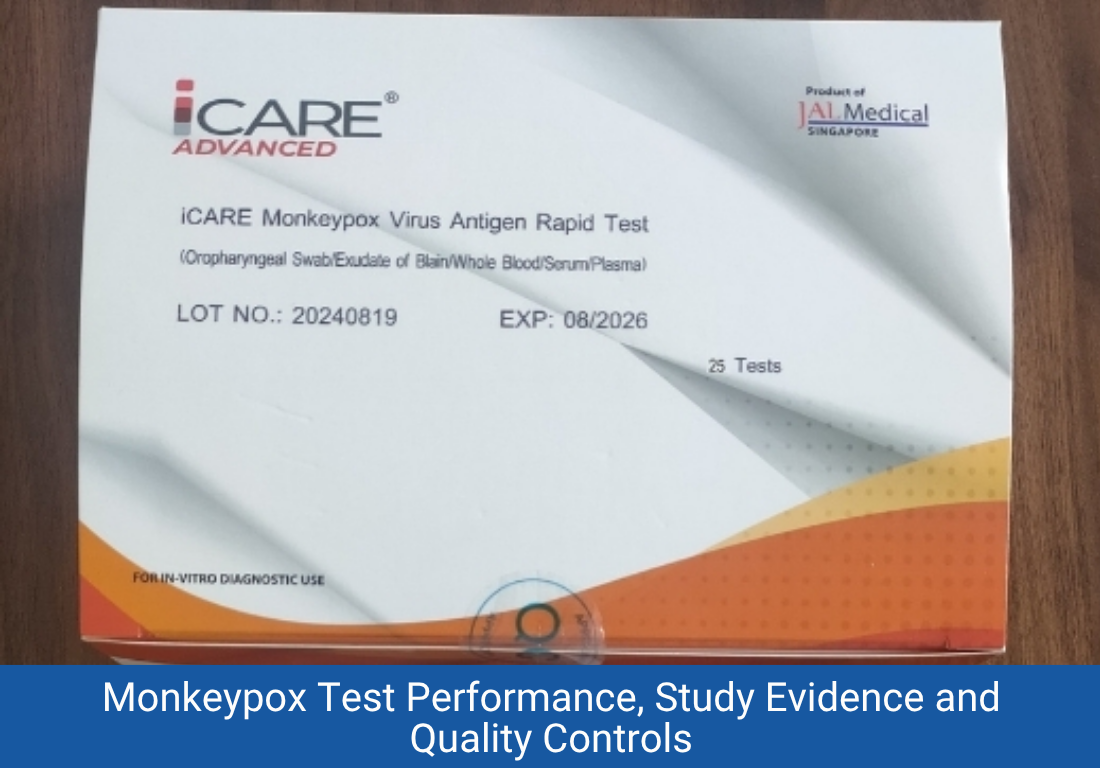
JAL Medical offers the iCare Monkeypox Virus Antigen Rapid Test, positioned on its official product page for professional in vitro diagnostic use in hospitals, clinics, and laboratories, with bulk supply and export support for institutional buyers.
Final Considerations for Monkeypox Virus Test Kit Procurement
A Monkeypox Virus Test Kit should be evaluated against documented evidence, not turnaround time or price. Intended use, validated specimens, transparent performance data, and quality documentation all shape reliability. Any antigen rapid test should therefore be evaluated against its official instructions, destination market authorization and current public health guidance before procurement.
Frequently Asked Questions
What should buyers do if product claims conflict with public health guidance?
Buyers should pause procurement and request clarification from relevant regulatory authority, and qualified clinical or laboratory personnel. Product marketing should not override applicable national requirements or current diagnostic guidance.
How should buyers verify destination market authorization?
Buyers should confirm whether a Monkeypox Virus Test Kit holds valid authorization, registration, or free sale documentation for the destination market, since requirements vary by country.
What minimum remaining shelf life should be specified?
Procurement agreements should specify a minimum remaining shelf life at both dispatch and delivery, accounting for shipping duration, customs clearance, and expected consumption. Total documented shelf life alone does not guarantee sufficient usable time after import, so buyers should request this figure explicitly before finalizing an order.
How should lot to lot consistency be reviewed?
Buyers should request certificate of analysis documentation for each lot and confirm whether the supplier maintains consistent manufacturing and quality control procedures across batches. Reviewing lot specific documentation helps identify variation in performance or stability before large volume procurement or distribution commitments are made.
What post market support should a supplier provide?
A reliable supplier should offer complaint handling and adverse event reporting, along with technical support after delivery. Buyers should confirm how issues are reported and resolved, since post market support determines how quickly problems are addressed once a kit is already in clinical or field use.