

Table of Contents
AI Summary:
A Rapid Multi Drug Screening Test gives a presumptive result within minutes at the point of collection, while laboratory drug testing can involve an immunoassay screen followed by a confirmatory method such as chromatography with mass spectrometry. The iCARE One Step Multi-Drug Screening Test from JAL Medical (jalmedical.com) is a qualitative, competitive lateral flow immunoassay in configurable panels of 1 to 14 indicators, read at 3 minutes and not interpreted after 8. This article compares both approaches across workflow, accuracy, applications, and procurement.
Rapid Multi Drug Screening Test vs Laboratory Drug Testing: The Core Difference
A Rapid Multi Drug Screening Test and laboratory drug testing are not competing for the same job; each answers a different question. Rapid screening flags, at the point of collection, whether a specimen may contain a targeted drug class at or above a set cutoff, using an immunoassay drug test format built for speed rather than final identification.
Laboratory drug testing can itself describe more than one stage: an immunoassay screen similar to a rapid device, or a confirmatory method identifying a specific compound. Point of care drug testing and confirmatory drug testing sit at different points on this pathway, and which one an organisation reaches for depends on the purpose of testing.
 Email Us Today!
What Is a Rapid Multi Drug Screening Test?
A Rapid Multi Drug Screening Test is an immunoassay drug test built on a competitive lateral flow format. Drug in the specimen competes with a labelled drug conjugate for limited antibody binding sites: a target at or above the cutoff blocks the conjugate and no test line forms, while a specimen below the cutoff lets the line appear.
A reactive result is presumptive, not proof of a specific substance, dose, timing, or impairment. A negative result means the targeted analyte was not detected at or above the relevant cutoff; it does not rule out every substance or time of use.
Panel coverage also varies by configuration, since a device may be assembled to screen anywhere from 1 to 14 indicators; the iCARE test from JAL Medical, covered later, follows this same configurable principle. The indicators on one configuration are separate from how conclusively a positive can be identified.
How Does Laboratory Drug Testing Work?
Laboratory drug testing is not a single step. Many programmes begin with an automated immunoassay screen, which works on the same threshold principle as a rapid device and is itself only presumptive.
A positive from that screen can move into a confirmatory method such as chromatography with mass spectrometry, identifying the specific compound. Confirmation availability, method, analyte coverage, and turnaround depend on the laboratory and programme behind it, so not every laboratory result reaches the confirmatory stage, and not every rapid result needs to be referred onward.
Rapid Multi Drug Screening Test vs Laboratory Analysis: A Direct Comparison
| Comparison Factor | Rapid Multi Drug Screening Test | Laboratory Drug Analysis |
| Main purpose | Initial, presumptive screening | Screening or confirmatory identification |
| Typical method | Qualitative lateral flow immunoassay | Immunoassay, or chromatography with mass spectrometry |
| Testing setting | Point of care or another authorised site | Qualified laboratory |
| Result type | Presumptive, qualitative | Presumptive or confirmatory, depending on method |
| Equipment needs | Minimal, device level | Dedicated laboratory instruments |
| Scope | Target drug class or configured panel | Specific drug or metabolite at the confirmatory stage |
| Interpretation | Threshold crossed or not crossed | Depends on stage: screen or confirmation |
| Operational need | Trained user, no laboratory infrastructure | Laboratory infrastructure and trained analysts |
Turnaround Time: Rapid Drug Screening Test vs Laboratory Workflow
A rapid device compresses collection, reaction, and reading into one step at the point of care, so a result is available within minutes, a clear advantage over routing every specimen through a laboratory first.
A laboratory pathway adds stages a rapid device skips: transport, accessioning, batch scheduling, the analytical run, and technical review before release. When a presumptive positive is referred for confirmation, only that smaller subset travels the full pathway, so the added time applies to fewer specimens.
Our Other Product
STD Rapid Test Kit (HIV 1&2 Oral Swab, Chlamydia, Hepatitis Test)Drug Screening Accuracy and Result Interpretation
Drug screening accuracy depends on cutoff concentration, cross-reactivity, specimen quality, and timing of collection, not on one figure that applies everywhere. A cutoff is the threshold at or above which a method reports a drug as present, and devices or protocols can set it differently, one reason results from two tests are not always comparable.
Certain medications can cross-react with immunoassay antibodies and occasionally produce a positive for a substance never used, one reason a reactive result is treated as presumptive. A false negative can occur when a specimen is diluted or concentration falls just under the cutoff.
When Confirmatory Drug Testing Is Needed
Confirmatory drug testing becomes appropriate whenever a result carries meaningful clinical, employment, legal, or other consequence, since a presumptive finding alone should not settle a matter with that much at stake. A workplace programme responding to a reactive screen typically secures the specimen and initiates confirmation before any further action.
Confirmation is also useful when a screen returns an unexpected result, or a specific compound and concentration need establishing rather than only a class-level flag.
Point of Care Drug Testing: Applications and Preferred Settings
Point of care drug testing appears across institutional settings, each using the immediate result differently. Hospitals may use it to support an initial assessment alongside other clinical findings, treatment programmes for ongoing monitoring, and occupational health or pre-employment programmes as a first screen.
Hospitals and organisations tend to prefer rapid screening when a fast, presumptive result can support that initial assessment without requiring confirmatory certainty at the same stage. High specimen volume, limited laboratory access, and same-day throughput needs all favour rapid screening as the first step.
Where a single result carries a legal or employment consequence, organisations typically weight the process toward laboratory confirmation instead.
Choosing and Evaluating a Multi Drug Screening Test Kit
Selecting a method and evaluating a kit are really one decision: which approach fits the need, when to route a result toward confirmation, and what to check before purchasing.
| Testing Need | Suggested Approach |
| Immediate, presumptive result | Point of care rapid screening |
| Several drug classes from one specimen | A Multi Drug Screening Test Kit matched to the required panel |
| Legally defensible or high-consequence result | Laboratory confirmation under an applicable protocol |
| Definitive identification of a specific compound | Confirmatory drug testing such as chromatography with mass spectrometry |
Beyond matching the method to the need, buyers should look at the complete testing pathway a purchase creates, not the unit price alone: intended use, specimen type and collection procedure, and the exact drug panel required.
Cutoff values, cross-reactivity, and performance evidence for that specific configuration matter too, along with quality control materials, storage, shelf life, and regulatory requirements, since panels and instructions differ between configurations of the same product line.
 Call Us Now!
JAL Medical: Multi-Drug Screening Test Manufacturers and the iCARE One Step Test
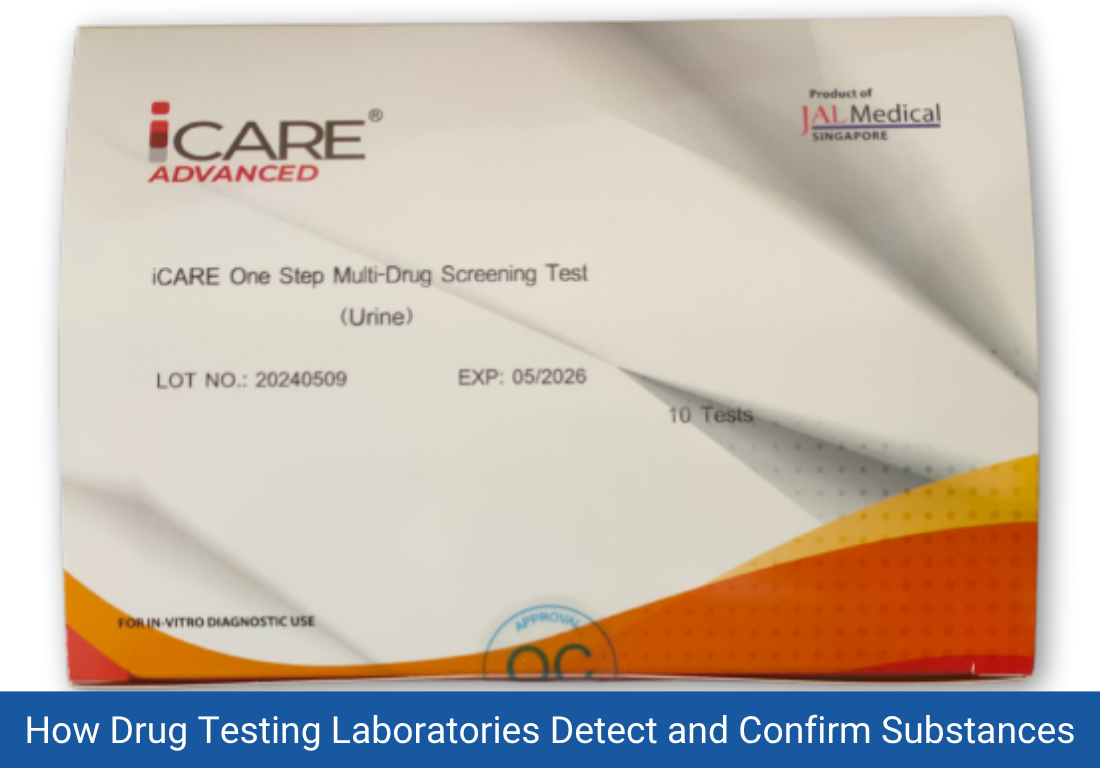
JAL Medical, based in Singapore, supplies the iCARE One Step Multi-Drug Screening Test, a rapid, qualitative, competitive lateral flow immunoassay detecting drugs of abuse and their metabolites in human urine. It is available in configurable panels of 1 to 14 indicators covering common drug classes such as amphetamines, opiates, cocaine, and THC; the full indicator list and configuration options are on JAL Medical’s product page, so buyers should confirm the exact panel for their chosen model rather than assume full coverage.
The test comes in strip, card, and cup formats, each with its own reference numbers; JAL Medical’s operating procedure specifies a 3-minute read and an 8-minute cutoff for all three. A negative shows both a control and test line, a positive shows the control line alone, and a missing control line is invalid. JAL Medical manufactures and supplies multi-drug screening tests to international buyers, with the iCARE range reaching 57 African countries, the Caribbean, and Central Asia; buyers can reach the company at [email protected] to confirm configuration and regulatory status.
Our Other Product
Drug of Abuse Rapid Screen TestsConclusion
Neither a Rapid Multi Drug Screening Test nor laboratory drug analysis replaces the other; each suits a different stage of the same pathway, and some programmes combine rapid screening with laboratory confirmation when required. A device such as JAL Medical’s iCARE test, discussed above, shows how one configurable kit fills that rapid screening role.
What changes between organisations is the proportion of specimens handled at each stage, based on specimen volume, panel needs, regulations, and how much consequence rides on a result. Reviewing that proportion periodically keeps a programme matched to its needs as those shift.
Frequently Asked Questions
What does a Rapid Multi Drug Screening Test detect?
It detects targeted drugs of abuse and their metabolites in human urine, reporting whether each targeted class meets the test's cutoff. Coverage ranges from 1 to 14 indicators depending on configuration, so exact analytes vary by model.
How is a rapid drug screening test different from laboratory drug testing?
A rapid test gives a presumptive, point of care result within minutes using a lateral flow immunoassay. Laboratory drug testing can involve the same type of screen, followed where needed by a confirmatory method identifying a specific compound.
Is a positive rapid drug screen a confirmed result?
No. A reactive result is presumptive and indicates the analyte met the device's cutoff. It does not by itself confirm a specific substance, dose, timing, or impairment.
Can a negative rapid test rule out drug use?
A negative result means the analyte was not detected at or above the relevant cutoff. It does not exclude every substance, concentration, or possible time of use outside that window.
What factors affect drug screening accuracy?
Cutoff concentration, cross-reactivity with certain medications, specimen quality, and timing of collection all influence a result, for rapid devices and laboratory screens alike.
When is confirmatory drug testing appropriate?
Confirmatory testing is appropriate when a result carries significant clinical, employment, legal, or other consequence, or a specific compound and concentration must be established.
Can rapid testing be used at the point of care?
Yes. A Rapid Multi Drug Screening Test is designed for point of care use, giving hospitals and other authorised settings a presumptive result without dedicated laboratory infrastructure on site.
What should hospitals and distributors check before choosing a multi drug test?
Confirm intended use, specimen type, required drug panel for that specific configuration, cutoff values, available performance evidence, storage and shelf life, and regulatory requirements for the destination market.